2025.12.19 UP
【SHOWCASE UENO】#17. 欧 静薇 / Jingwei Ou 《海と手のあいだ / Between the Sea and Hands》
ショーケース上野 SHOWCASE UENO #17
2025.12.11ー2026.1.26
会場:東京藝術大学上野キャンパス 大学会館 GEIDAI LIVING前
at the Entrance of GEIDAI LIVING, University Hall, Tokyo University of the Arts(Ueno Campus)
欧 静薇(オウ ジンウェイ)
《海と手のあいだ》
2025年
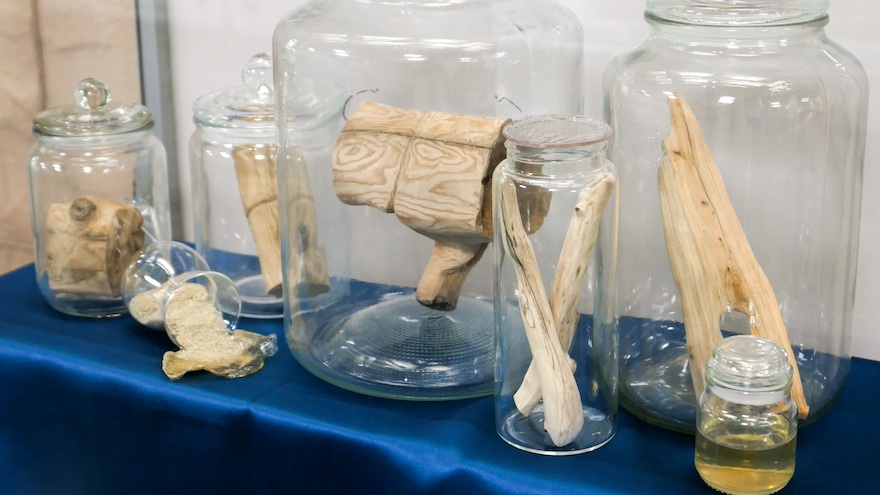
ガラス瓶、流木、ゼラチン、砂、布、釣り針、糸
2026/3/15update: インタビュー記事 はこちら
海辺に座り、波の音に耳を澄ますと、呼吸が海のリズムと同調して
水平線の向こうに目を凝らす。目の届かないところで、いったい何
海から来た流木は、いくつもの波を越え、やがて浜にたどり着く。
海のすべてを知っている。
散歩していた私は、それと出会った。
キュレーターから
本作は、布の上に配置されたガラス瓶によって構成される。流木で
ガラス瓶は、作家の故郷にある海産物乾物店の陳列から着想を得て
魚骨からゼラチンへ、そしてゼラチンが流木を接着し舟を形づくる
これらの素材と形態の変遷は、海を越えて続いてきた変容と交換の
キュレーター:リ・アンチー
アーティストプロフィール
欧(オウ) 静薇(ジンウェイ)
2001 中国広東省生まれ
2023 中国中央戯劇学院 卒業
2024 東京藝術大学大学院 美術研究科 GAP専攻 入学
SHOWCASE UENO #17
Between the Sea and Hands
Jingwei Ou
2025
Glass containers, driftwood, gelatin, sand, cloth, fishhooks, threads
Sitting by the shore, I listen to the waves until my breath learns the
sea’s rhythm.
I gaze toward the horizon, wondering what waits beyond my sight.
Driftwood crosses countless waves before arriving at the shore,
carrying with it all the memories of the sea.
I picked it up on my walk.
From the curator:
This work brings together glass containers arranged on cloth: five
hold fish-bone forms made from driftwood, one contains gelatin, and
one releases falling sand.
The containers take inspiration from the displays of dried-seafood
shops in the artist’s hometown. By placing them in a showcase once
used for food samples, the work highlights an everyday yet historical
continuity shared by two maritime cultures: Japan’s coastal regions
and China’s Guangdong Province. In both places, people have long used
fish and wood without waste. They built their lives on the gifts of
the sea, shaping wood into boats and rowing out into the waves. In
Guangdong culture, a longstanding wisdom treats every part of the fish
as nourishment. Fish bones exist at once as waste and as a valuable
source of gelatin.
The transformation from fish bone to gelatin, and from gelatin to the
adhesive that binds driftwood into boats, traces a history that has
connected coastal regions across the sea, here suggested by sand. The
driftwood fish-bone forms carry memories of a time when both fish and
wood moved freely through the sea. Sealed inside glass containers,
they now remain still, unable to return.
Taken together, these materials and their transformations quietly
evoke a long history of exchange and change across the water.
Curator: Anqi Li
Biography
Jingwei Ou
2001 Born in Guangdong, China
2023 Graduated from the Central Academy of Drama, China
2024 Enrolled in Global Art Practice, Graduate School of Fine Arts at
Tokyo University of the Arts
2025.12.11ー2026.1.26
会場:東京藝術大学上野キャンパス 大学会館 GEIDAI LIVING前
at the Entrance of GEIDAI LIVING, University Hall, Tokyo University of the Arts(Ueno Campus)
欧 静薇(オウ ジンウェイ)
《海と手のあいだ》
2025年
ガラス瓶、流木、ゼラチン、砂、布、釣り針、糸
2026/3/15update: インタビュー記事 はこちら
海辺に座り、波の音に耳を澄ますと、呼吸が海のリズムと同調して
水平線の向こうに目を凝らす。目の届かないところで、いったい何
海から来た流木は、いくつもの波を越え、やがて浜にたどり着く。
海のすべてを知っている。
散歩していた私は、それと出会った。
キュレーターから
本作は、布の上に配置されたガラス瓶によって構成される。流木で
ガラス瓶は、作家の故郷にある海産物乾物店の陳列から着想を得て
魚骨からゼラチンへ、そしてゼラチンが流木を接着し舟を形づくる
これらの素材と形態の変遷は、海を越えて続いてきた変容と交換の
キュレーター:リ・アンチー
アーティストプロフィール
欧(オウ) 静薇(ジンウェイ)
2001 中国広東省生まれ
2023 中国中央戯劇学院 卒業
2024 東京藝術大学大学院 美術研究科 GAP専攻 入学
SHOWCASE UENO #17
Between the Sea and Hands
Jingwei Ou
2025
Glass containers, driftwood, gelatin, sand, cloth, fishhooks, threads
Sitting by the shore, I listen to the waves until my breath learns the
sea’s rhythm.
I gaze toward the horizon, wondering what waits beyond my sight.
Driftwood crosses countless waves before arriving at the shore,
carrying with it all the memories of the sea.
I picked it up on my walk.
From the curator:
This work brings together glass containers arranged on cloth: five
hold fish-bone forms made from driftwood, one contains gelatin, and
one releases falling sand.
The containers take inspiration from the displays of dried-seafood
shops in the artist’s hometown. By placing them in a showcase once
used for food samples, the work highlights an everyday yet historical
continuity shared by two maritime cultures: Japan’s coastal regions
and China’s Guangdong Province. In both places, people have long used
fish and wood without waste. They built their lives on the gifts of
the sea, shaping wood into boats and rowing out into the waves. In
Guangdong culture, a longstanding wisdom treats every part of the fish
as nourishment. Fish bones exist at once as waste and as a valuable
source of gelatin.
The transformation from fish bone to gelatin, and from gelatin to the
adhesive that binds driftwood into boats, traces a history that has
connected coastal regions across the sea, here suggested by sand. The
driftwood fish-bone forms carry memories of a time when both fish and
wood moved freely through the sea. Sealed inside glass containers,
they now remain still, unable to return.
Taken together, these materials and their transformations quietly
evoke a long history of exchange and change across the water.
Curator: Anqi Li
Biography
Jingwei Ou
2001 Born in Guangdong, China
2023 Graduated from the Central Academy of Drama, China
2024 Enrolled in Global Art Practice, Graduate School of Fine Arts at
Tokyo University of the Arts