2026.03.15 UP NEW!
【SHOWCASE UENO】#17. 欧 静薇 / Jingwei Ou インタビュー|リ・アンチー
【SHOWCASE UENO】#17. 欧 静薇 / Jingwei Ou インタビュー|リ・アンチー
English Follows,
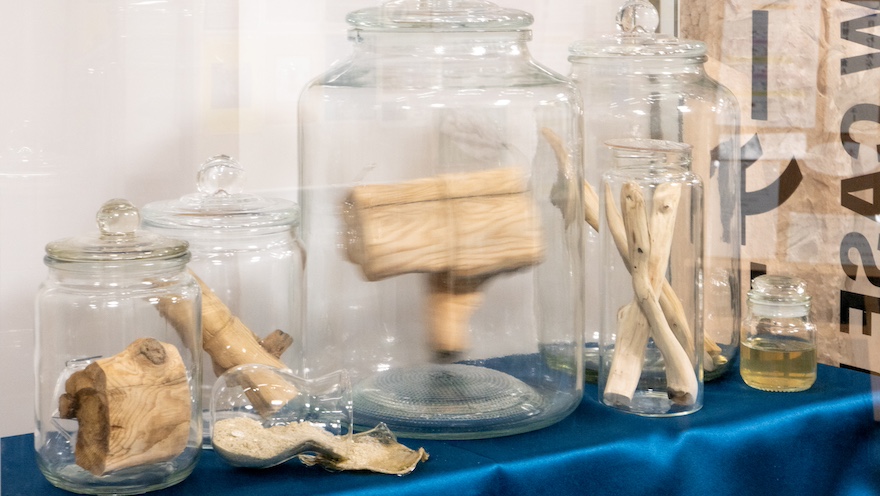
設営前夜、日付が変わる前に地震が起きた。欧 静薇(オウ ジンウェイ)はバルコニーにいた。そこは、制作のために使っていた仮のアトリエでもあった。ガラス容器の中で、釣り糸とフックに吊られた流木が揺れ、壁に当たる音がした。揺れが収まっても、木はしばらく動き続けていた。欧はその様子を見つめていた。動きは外から与えられた力の名残というより、素材自身が動いているように感じられた。
その少し前、欧は「形を詰めているところ」と書き添えて写真を送ってきた。ここに至るまでの数週間、彼女は取手の木工房で流木を削り、磨き続けていた。作業を重ねるうちに、魚の骨のような形が、イメージとしても実体としても、少しずつ立ち上がってきた。
海は、欧の作品に繰り返し現れるテーマであり、出発点でもある。きっかけの一つは、モニラ・アル・カディリによるオーラルヒストリーのレクチャーだった。それ以降、海沿いにある故郷を見直すようになり、同時に、近年訪れたさまざまな海辺ともつながっていった。香港やマレーシアでは、かつて水上生活者が暮らしていた地域を訪れ、そこで出会った社会現実が強く印象に残った。帰国後、明確な物語やメッセージを定めないまま制作を始め、手を動かし続けるなかで、流木は自然と形を持っていった。完成したとき、素材そのものが言葉を持ち始めていると感じたという。
《海と手のあいだ》は、欧にとって初めての静的なインスタレーションであり、写真や映像を用いていない。以前に大学会館で展示された作品とは対照的だ。当時は、花膠(干し魚の浮き袋)だけで意図が伝わるのか不安があり、プロジェクションに頼っていた。だが、プロジェクションには暗さが必要になる。講評では、なぜ作品がいつも暗い空間を前提にしているのか、と繰り返し問われた。
今回は、ショーケース上野という場所の条件から、プロジェクションを使うことができなかった。その結果、欧は素材そのものと向き合うことになった。これは、慣れた方法を手放す経験でもあった。欧は演劇をバックグラウンドに持つ。学部時代には、多くの演劇プロジェクトに関わり、ドラマトゥルクとして名を連ねながら、実際には演出や舞台美術、道具制作、時には俳優まで担っていた。演劇は強い協働を前提とする。特にパンデミック期、若者たちが集まり、声を上げ、集団として表現する場だったことを、彼女は強く記憶している。その一方で、立ち止まって考える余裕はほとんどなかった。
演劇から距離を置いた理由の一つは、経済的な現実だった。演劇制作には多くの資源が必要で、学校を出たあと、個人で続けることは難しくなっていった。欧は従来の制作プロセスに疲れを感じるようになった。物語を語りたい気持ちは残っていたが、ひとつの媒体に縛られることは望まなくなった。すべての物語を人間が語る必要はない。素材そのものも語りうる。その感覚が、より身近な制作へと彼女を導き、中国を離れて東京藝術大学のGAP(Global Art Practice)に進学することにつながった。
藝大では、GAPや相馬千秋のような先生の存在が、大きな影響を与えた。相馬は、物語を扱うアーティストと一緒に考えながら、リサーチをどうやって視覚表現にしていくかを重視している。その姿勢は、演劇とインスタレーションを切り分けるのではなく、両者を行き来しながら考える可能性を示していた。三年間、欧は、GAPの開かれた雰囲気や、同級生どうしのあいだで自然に行き交う情報、はっきりしないまま試していける自由のなかで制作を続けていた。ワークショップや展示は、その都度、考え途中のアイデアを確かめる場になっていた。
演劇とインスタレーションは似て見えても、内部の論理は異なる。演劇は、その場で生まれる演者と観客の関係に支えられている。一方、インスタレーションは構成が中心になる。多くの場合、鑑賞者の反応によって作品が変化することはない。そこにあるのは、即時的な応答よりも、解釈の関係である。
欧は、どちらが優れているとも考えていない。演劇には、集団で考える時間があり、生の場で共有される体験がある。インスタレーションは、ひとりで進められるが、長い時間をかけた調整を求められる。彼女にとって重要なのはジャンルではない。演劇を通じて身についた、「特定の状況にいる特定の人に向き合う」感覚は、今も制作の基盤になっている。一方で、空間を埋めすぎてしまう癖が、観客の注意を失うことへの不安から来ていたことにも、後から気づいた。
この作品で欧は木を彫った。軽く、即時的な映像とは異なり、木は重く、時間がかかり、継続的な身体の関与を必要とする。最初は、木を何か現実に存在するものに似せることだった。しかし作業を重ねるうちに、流木が持つ不均一な表面や、へこみ、歪みといった性質そのものに、次第に惹かれていった。
今後について欧は、「ちゃんとした仕事が必要だ」と語っている。プロのアーティストとしての道を選ぶつもりはないという。その道には、継続的な制作が当然のように求められ、それに耐え続ける強さが必要だと感じてきたからだ。つくりたいという衝動はあるが、それは一定ではない。彼女の制作のペースは遅く、波がある。創作は常に資源に支えられており、継続的に活動するには、強い経済的、あるいは制度的な基盤が必要になる。それでも、一度つくることの喜びを知ってしまった以上、やめることはできない。
欧は、中国と日本で経験した社会環境の違いにも触れている。中国では、若者としての自分が代替可能な存在に感じられ、その分、個人的な人間関係がより重要になっていた。日本では、自分自身の視点を保ちやすいと感じているが、留学生として、芸術、労働、政治が重なり合う構造的な制約にも直面している。東京都劇場のあるプロジェクトでは、公募要項に国籍の条件が記されていなかったにもかかわらず、ビザの要件を理由に参加できなかったことを、後から知った。学生ビザでは日本で働くことは可能だが、週二十八時間という制限があり、そのため長期間のリハーサルに参加できなかった。主宰アーティストは協働に関心を示していたが、この制限が障壁となった。岡田利規が作者と演出を担った演劇《宇宙船イン・ビトウィーンの窓》のように、外国人出演者に合わせて稽古時間を調整した例もあるが、これは非母語話者の日本語を前提に作品が構想されていた場合に限られる。多くの現場では日本人が優先され、交渉の余地はほとんど残されていない。
私たちの会話は、やがて「つくる権利は、誰のものなのか」という問いに向かった。かつて藝大は、「ベスト」なアーティストを生み出すことを誇りとしてきた。しかし、藝大のような場が開かれていくなかで、制作は能力主義の枠を超えていく。アーティストであるために、「ベスト」である必要はない。
つくることに、許可は必要ない。
東京藝術大学 大学院国際芸術創造研究科 修士課程
アートプロデュース専攻 キュレーション領域
リ・アンチー
・・・
It was close to midnight when the earthquake came on the night before the installation. Ou Jingwei was on the balcony, her temporary studio, adjusting the work. She watched the movement of the driftwood suspended by fishing wire and hooks in a glass container, knocking against the wall at times. After the shaking stopped, the wood continued to swing for a while. Ou stood there watching, as if the movement were no longer simply the result of an external force, but something self-directed, as though the material itself had begun to act on its own.
Earlier that night, Ou sent me a photo, writing that she was finalizing the form. In the weeks leading up to this moment, she had been working from nine to five at the Toride wood shop, carving and polishing driftwood. Slowly, fish bones emerged, both as metaphor and physical form.
The sea runs through Ou’s works as both theme and reference. This can be traced back to Monira Al Qadiri’s lecture on oral history, which prompted Ou to look again at her hometown by the sea, but it also connects to her recent travels to other seaside places. In Hong Kong and Malaysia, she visited areas once inhabited by boat people and encountered social realities that stayed with her. After returning, she began making this work without a clear story or message in mind. Through repeated handling and adjustment, the driftwood gradually took shape. Only when everything was assembled did she realize that the materials had formed a language of their own.
Between the Sea and Hands is Ou Jingwei’s first still installation, containing no images or video. It stands in clear contrast to her previous works, particularly the one shown at the University Hall exhibition. At that time, she was unsure whether fish maw alone could convey her message, so she relied on projected images and video to fill the space. Projection, however, requires darkness. During critiques, she was repeatedly asked why her works always depended on dark environments.
This time, the location of Showcase Ueno made projection impossible. Without that option, Ou had to confront the work materially. She described this as being forced to let go of a familiar approach, and this shift extended beyond projection itself. Ou comes from a theatre background. During her undergrad, she worked on many theatre projects, including both original productions and adaptations. Although her official role was dramaturg, in practice she often took on other positions, including director, stage designer, prop maker, and occasionally actor. Theatre demanded intense collaboration. She recalls that period, especially during the pandemic, as emotionally charged, with young people gathering, protesting, and expressing themselves collectively. At the same time, being immersed in that collective momentum left little room for reflection.
Ou left theatre for several reasons, the most immediate being financial. Theatre production is expensive and dependent on resources, space, and coordination. After leaving school, independent creation became increasingly difficult. Ou grew tired of conventional theatre-making processes. Her impulse to tell stories did not disappear, but she no longer wanted to be confined to a single medium. She does not believe all stories need to be told by humans. Nonhuman materials can also communicate. This understanding led her toward more accessible forms of making, and eventually to leave China and join the GAP program at Tokyo University of the Arts (Geidai).
At Geidai, the GAP program and professors such as Chiaki Soma became important influences. Soma works closely with artists engaged in storytelling, guiding them from research toward visual expression. This approach showed Ou the possibility of integrating theatre and installation. Over three years, she benefited from the openness of the program, the information flow among peers, and the freedom to experiment without full clarity. Through workshops and exhibitions, she could test ideas in progress.
Reflecting on the difference between theatre and installation, Ou notes that while the two may appear similar, their internal logics differ. Theatre depends on real-time relational responses between performers and audiences. Installation, by contrast, centers on composition. Even when interactive, most installations do not change in response to viewers. The relationship is more often one of interpretation than immediate feedback.
Ou does not see installation as superior to theatre, or vice versa. Theatre allows ideas to emerge through group discussion, and she values the collective experience that theatre creates. For her, nothing replaces the shared time and space of a live performance. Installation, meanwhile, allows her to work independently, but it also demands long periods of solitary revision and fine-tuning. For her, strong works speak beyond genre. Theatre trained her to focus on specific people in specific situations. Now, she begins directly from the issues that interest her, without relying on scripts, stages, or actors. Some habits persist. She came to realize that her impulse to fill space stemmed from a fear of losing the audience’s attention. Excessive fullness, however, can also obscure what matters most.
In this work, Ou chose to carve wood. Unlike the lightness and speed of projection, wood is heavy and slow, requiring sustained physical engagement. At first, her aim was simply to make the wood resemble something real. Over time, she became drawn to the driftwood’s uneven surfaces, concavities, and patterns.
Looking ahead, Ou says that she needs a “real job.” She does not plan to follow the path of a professional artist. She has observed the level of perseverance such a path demands, including the expectation of constant production. Her impulse to create remains, but it is not continuous. Her pace is slow and uneven. Creation, she realized, always depends on resources, and a sustained artistic career requires strong economic or institutional support. Still, having experienced the joy of making, she cannot stop.
Ou also reflects on the social environments she has encountered in China and Japan. In China, she felt replaceable as a young person, which made personal relationships more central. In Japan, she feels it is more possible to retain her own perspective. At the same time, as an international student, she faces structural constraints shaped by the relationship between art, labour, and politics. She learned indirectly that she had been rejected by a project at Tokyo Metropolitan Theatre due to visa requirements, even though the original open call did not specify nationality. Her student visa allows her to work legally in Japan, but only up to twenty-eight hours per week. Although the lead artist expressed interest in collaborating with her, the twenty-eight-hour limit prevented her from participating in long rehearsal periods. There are exceptions, such as Toshiki Okada’s The Window of Spaceship “In-Between,” which adjusted its rehearsal structures to accommodate foreign participants. This was possible because the work was conceived with non-native Japanese speech at its core. In most cases, however, Japanese candidates are selected over non-Japanese candidates, with little room for negotiation.
Our conversation eventually turned to the question of who has the right to create. Geidai once prided itself on producing the “best” artists. As institutions like Geidai open up, art-making moves beyond meritocracy. One does not need to be the best to be an artist.
No one can stop us from creating.
Tokyo University of the Arts, Graduate School of Global Arts
Department of Arts Studies and Curatorial Practices, Curation
Anqi Li
English Follows,
欧 静薇:演劇とインスタレーションのあいだ
設営前夜、日付が変わる前に地震が起きた。欧 静薇(オウ ジンウェイ)はバルコニーにいた。そこは、制作のために使っていた仮のアトリエでもあった。ガラス容器の中で、釣り糸とフックに吊られた流木が揺れ、壁に当たる音がした。揺れが収まっても、木はしばらく動き続けていた。欧はその様子を見つめていた。動きは外から与えられた力の名残というより、素材自身が動いているように感じられた。
その少し前、欧は「形を詰めているところ」と書き添えて写真を送ってきた。ここに至るまでの数週間、彼女は取手の木工房で流木を削り、磨き続けていた。作業を重ねるうちに、魚の骨のような形が、イメージとしても実体としても、少しずつ立ち上がってきた。
海は、欧の作品に繰り返し現れるテーマであり、出発点でもある。きっかけの一つは、モニラ・アル・カディリによるオーラルヒストリーのレクチャーだった。それ以降、海沿いにある故郷を見直すようになり、同時に、近年訪れたさまざまな海辺ともつながっていった。香港やマレーシアでは、かつて水上生活者が暮らしていた地域を訪れ、そこで出会った社会現実が強く印象に残った。帰国後、明確な物語やメッセージを定めないまま制作を始め、手を動かし続けるなかで、流木は自然と形を持っていった。完成したとき、素材そのものが言葉を持ち始めていると感じたという。
《海と手のあいだ》は、欧にとって初めての静的なインスタレーションであり、写真や映像を用いていない。以前に大学会館で展示された作品とは対照的だ。当時は、花膠(干し魚の浮き袋)だけで意図が伝わるのか不安があり、プロジェクションに頼っていた。だが、プロジェクションには暗さが必要になる。講評では、なぜ作品がいつも暗い空間を前提にしているのか、と繰り返し問われた。
今回は、ショーケース上野という場所の条件から、プロジェクションを使うことができなかった。その結果、欧は素材そのものと向き合うことになった。これは、慣れた方法を手放す経験でもあった。欧は演劇をバックグラウンドに持つ。学部時代には、多くの演劇プロジェクトに関わり、ドラマトゥルクとして名を連ねながら、実際には演出や舞台美術、道具制作、時には俳優まで担っていた。演劇は強い協働を前提とする。特にパンデミック期、若者たちが集まり、声を上げ、集団として表現する場だったことを、彼女は強く記憶している。その一方で、立ち止まって考える余裕はほとんどなかった。
演劇から距離を置いた理由の一つは、経済的な現実だった。演劇制作には多くの資源が必要で、学校を出たあと、個人で続けることは難しくなっていった。欧は従来の制作プロセスに疲れを感じるようになった。物語を語りたい気持ちは残っていたが、ひとつの媒体に縛られることは望まなくなった。すべての物語を人間が語る必要はない。素材そのものも語りうる。その感覚が、より身近な制作へと彼女を導き、中国を離れて東京藝術大学のGAP(Global Art Practice)に進学することにつながった。
藝大では、GAPや相馬千秋のような先生の存在が、大きな影響を与えた。相馬は、物語を扱うアーティストと一緒に考えながら、リサーチをどうやって視覚表現にしていくかを重視している。その姿勢は、演劇とインスタレーションを切り分けるのではなく、両者を行き来しながら考える可能性を示していた。三年間、欧は、GAPの開かれた雰囲気や、同級生どうしのあいだで自然に行き交う情報、はっきりしないまま試していける自由のなかで制作を続けていた。ワークショップや展示は、その都度、考え途中のアイデアを確かめる場になっていた。
演劇とインスタレーションは似て見えても、内部の論理は異なる。演劇は、その場で生まれる演者と観客の関係に支えられている。一方、インスタレーションは構成が中心になる。多くの場合、鑑賞者の反応によって作品が変化することはない。そこにあるのは、即時的な応答よりも、解釈の関係である。
欧は、どちらが優れているとも考えていない。演劇には、集団で考える時間があり、生の場で共有される体験がある。インスタレーションは、ひとりで進められるが、長い時間をかけた調整を求められる。彼女にとって重要なのはジャンルではない。演劇を通じて身についた、「特定の状況にいる特定の人に向き合う」感覚は、今も制作の基盤になっている。一方で、空間を埋めすぎてしまう癖が、観客の注意を失うことへの不安から来ていたことにも、後から気づいた。
この作品で欧は木を彫った。軽く、即時的な映像とは異なり、木は重く、時間がかかり、継続的な身体の関与を必要とする。最初は、木を何か現実に存在するものに似せることだった。しかし作業を重ねるうちに、流木が持つ不均一な表面や、へこみ、歪みといった性質そのものに、次第に惹かれていった。
今後について欧は、「ちゃんとした仕事が必要だ」と語っている。プロのアーティストとしての道を選ぶつもりはないという。その道には、継続的な制作が当然のように求められ、それに耐え続ける強さが必要だと感じてきたからだ。つくりたいという衝動はあるが、それは一定ではない。彼女の制作のペースは遅く、波がある。創作は常に資源に支えられており、継続的に活動するには、強い経済的、あるいは制度的な基盤が必要になる。それでも、一度つくることの喜びを知ってしまった以上、やめることはできない。
欧は、中国と日本で経験した社会環境の違いにも触れている。中国では、若者としての自分が代替可能な存在に感じられ、その分、個人的な人間関係がより重要になっていた。日本では、自分自身の視点を保ちやすいと感じているが、留学生として、芸術、労働、政治が重なり合う構造的な制約にも直面している。東京都劇場のあるプロジェクトでは、公募要項に国籍の条件が記されていなかったにもかかわらず、ビザの要件を理由に参加できなかったことを、後から知った。学生ビザでは日本で働くことは可能だが、週二十八時間という制限があり、そのため長期間のリハーサルに参加できなかった。主宰アーティストは協働に関心を示していたが、この制限が障壁となった。岡田利規が作者と演出を担った演劇《宇宙船イン・ビトウィーンの窓》のように、外国人出演者に合わせて稽古時間を調整した例もあるが、これは非母語話者の日本語を前提に作品が構想されていた場合に限られる。多くの現場では日本人が優先され、交渉の余地はほとんど残されていない。
私たちの会話は、やがて「つくる権利は、誰のものなのか」という問いに向かった。かつて藝大は、「ベスト」なアーティストを生み出すことを誇りとしてきた。しかし、藝大のような場が開かれていくなかで、制作は能力主義の枠を超えていく。アーティストであるために、「ベスト」である必要はない。
つくることに、許可は必要ない。
東京藝術大学 大学院国際芸術創造研究科 修士課程
アートプロデュース専攻 キュレーション領域
リ・アンチー
・・・
Ou Jingwei: Between Theatre and Installation
It was close to midnight when the earthquake came on the night before the installation. Ou Jingwei was on the balcony, her temporary studio, adjusting the work. She watched the movement of the driftwood suspended by fishing wire and hooks in a glass container, knocking against the wall at times. After the shaking stopped, the wood continued to swing for a while. Ou stood there watching, as if the movement were no longer simply the result of an external force, but something self-directed, as though the material itself had begun to act on its own.
Earlier that night, Ou sent me a photo, writing that she was finalizing the form. In the weeks leading up to this moment, she had been working from nine to five at the Toride wood shop, carving and polishing driftwood. Slowly, fish bones emerged, both as metaphor and physical form.
The sea runs through Ou’s works as both theme and reference. This can be traced back to Monira Al Qadiri’s lecture on oral history, which prompted Ou to look again at her hometown by the sea, but it also connects to her recent travels to other seaside places. In Hong Kong and Malaysia, she visited areas once inhabited by boat people and encountered social realities that stayed with her. After returning, she began making this work without a clear story or message in mind. Through repeated handling and adjustment, the driftwood gradually took shape. Only when everything was assembled did she realize that the materials had formed a language of their own.
Between the Sea and Hands is Ou Jingwei’s first still installation, containing no images or video. It stands in clear contrast to her previous works, particularly the one shown at the University Hall exhibition. At that time, she was unsure whether fish maw alone could convey her message, so she relied on projected images and video to fill the space. Projection, however, requires darkness. During critiques, she was repeatedly asked why her works always depended on dark environments.
This time, the location of Showcase Ueno made projection impossible. Without that option, Ou had to confront the work materially. She described this as being forced to let go of a familiar approach, and this shift extended beyond projection itself. Ou comes from a theatre background. During her undergrad, she worked on many theatre projects, including both original productions and adaptations. Although her official role was dramaturg, in practice she often took on other positions, including director, stage designer, prop maker, and occasionally actor. Theatre demanded intense collaboration. She recalls that period, especially during the pandemic, as emotionally charged, with young people gathering, protesting, and expressing themselves collectively. At the same time, being immersed in that collective momentum left little room for reflection.
Ou left theatre for several reasons, the most immediate being financial. Theatre production is expensive and dependent on resources, space, and coordination. After leaving school, independent creation became increasingly difficult. Ou grew tired of conventional theatre-making processes. Her impulse to tell stories did not disappear, but she no longer wanted to be confined to a single medium. She does not believe all stories need to be told by humans. Nonhuman materials can also communicate. This understanding led her toward more accessible forms of making, and eventually to leave China and join the GAP program at Tokyo University of the Arts (Geidai).
At Geidai, the GAP program and professors such as Chiaki Soma became important influences. Soma works closely with artists engaged in storytelling, guiding them from research toward visual expression. This approach showed Ou the possibility of integrating theatre and installation. Over three years, she benefited from the openness of the program, the information flow among peers, and the freedom to experiment without full clarity. Through workshops and exhibitions, she could test ideas in progress.
Reflecting on the difference between theatre and installation, Ou notes that while the two may appear similar, their internal logics differ. Theatre depends on real-time relational responses between performers and audiences. Installation, by contrast, centers on composition. Even when interactive, most installations do not change in response to viewers. The relationship is more often one of interpretation than immediate feedback.
Ou does not see installation as superior to theatre, or vice versa. Theatre allows ideas to emerge through group discussion, and she values the collective experience that theatre creates. For her, nothing replaces the shared time and space of a live performance. Installation, meanwhile, allows her to work independently, but it also demands long periods of solitary revision and fine-tuning. For her, strong works speak beyond genre. Theatre trained her to focus on specific people in specific situations. Now, she begins directly from the issues that interest her, without relying on scripts, stages, or actors. Some habits persist. She came to realize that her impulse to fill space stemmed from a fear of losing the audience’s attention. Excessive fullness, however, can also obscure what matters most.
In this work, Ou chose to carve wood. Unlike the lightness and speed of projection, wood is heavy and slow, requiring sustained physical engagement. At first, her aim was simply to make the wood resemble something real. Over time, she became drawn to the driftwood’s uneven surfaces, concavities, and patterns.
Looking ahead, Ou says that she needs a “real job.” She does not plan to follow the path of a professional artist. She has observed the level of perseverance such a path demands, including the expectation of constant production. Her impulse to create remains, but it is not continuous. Her pace is slow and uneven. Creation, she realized, always depends on resources, and a sustained artistic career requires strong economic or institutional support. Still, having experienced the joy of making, she cannot stop.
Ou also reflects on the social environments she has encountered in China and Japan. In China, she felt replaceable as a young person, which made personal relationships more central. In Japan, she feels it is more possible to retain her own perspective. At the same time, as an international student, she faces structural constraints shaped by the relationship between art, labour, and politics. She learned indirectly that she had been rejected by a project at Tokyo Metropolitan Theatre due to visa requirements, even though the original open call did not specify nationality. Her student visa allows her to work legally in Japan, but only up to twenty-eight hours per week. Although the lead artist expressed interest in collaborating with her, the twenty-eight-hour limit prevented her from participating in long rehearsal periods. There are exceptions, such as Toshiki Okada’s The Window of Spaceship “In-Between,” which adjusted its rehearsal structures to accommodate foreign participants. This was possible because the work was conceived with non-native Japanese speech at its core. In most cases, however, Japanese candidates are selected over non-Japanese candidates, with little room for negotiation.
Our conversation eventually turned to the question of who has the right to create. Geidai once prided itself on producing the “best” artists. As institutions like Geidai open up, art-making moves beyond meritocracy. One does not need to be the best to be an artist.
No one can stop us from creating.
Tokyo University of the Arts, Graduate School of Global Arts
Department of Arts Studies and Curatorial Practices, Curation
Anqi Li