ショーケース 上野
2026.06.12 UP
Part2-中編【SHOWCASE UENO】#18 藤井光 / Hikaru Fujii インタビュー Interview(JP/EN)|リ・アンチー / Anqi Li
Part2-中編
【SHOWCASE UENO】
#18 藤井光 / Hikaru Fujii インタビュー Interview(JP/EN)|リ・アンチー / Anqi Li
展示情報 Exhibition Information
English follows,
インタビュー( 前編 中編 後編 )
・・・
アンチー
イメージによっていろいろ想起される、まさにアートじゃないですか。
DANNY JINからパレスチナの歴史についていろいろ聞いたでしょう。でも藤井先生の作品はギリシャやフランスも含めつつ、日本に関して作っているものが多いじゃないですか。このショーケースのタイトル『なぜ、それを観るのか?』を読んで、芸大には私みたいな国際学生もいるけれど、メインのオーディエンスは日本人になるんですかね。観客についてどう思いますか。
藤井
日本人に向けてというのはちょっとずれるかな。日本人としての、ある種の「責任」を感じますけどね。
責任は英語でレスポンシビリティ(responsibility)で、語源的にはもう一度答える、未来に対して応える可能性を秘めた言葉ですよね。でも日本語で責任と言うと後ろ向きに聞こえるけど、もっと前向きな、未来を相互的に変えていく意味合いがある。
自分の場合、日本語も喋って日本で育ったし、男性という圧倒的な下駄を履いて生きてきた。さらに大学の先生になっちゃって、そういう意味で強者なんですよ。そういう自分が引き受ける責任(レスポンサビリティ response-ability)があって、何ができるか、考えて作る。もちろん批評性が日本人や日本の歴史に向く部分もあるけど、それは決して日本人に対して見せるだけではない。
例えばこの作品、『帝国の教育制度』は、韓国の国立現代美術館に収蔵されているけれど、日本が植民地として抑圧してきた韓国の歴史に対するレスポンサビリティでもあります。韓国の観衆と自分がどう新たな関係を築いていくか。そのときに気をつけていたのは、韓国にもある排他的なナショナリズムです。「良心的な日本の文化人」として受け入れられるっていうやり方ではない方法を探っていました。
だから作品を作るときには、国(ネーション)という枠を超える表現を模索しています。それは、「グローバル・アート・プラクティス」とは真逆で、ローカルに根差しながら地域性を越えていく作品にしたい。だから観客は日本人っていう設定は自分にはない。日本人も含む、もちろん国際学生も含むという感じ。時代も今だけじゃなくて、十年後も考えながら作っています。
アンチー
タイトルの『なぜ、それを観るのか?』という問いは観客に投げているのか、もしくは藤井先生自身に?
藤井
ショーケースはガラスケースで、しかも食堂の前に展示されている。本来はお皿が並ぶディスプレイで、それ自体が作り出す視線の構造がある。「見て!」というような。その構造自体を問うタイトルにしているので、観客に投げかけると同時に、その条件を言語化して、問いとして立て直しました。
アンチー
DANNY JINとのビデオクリップとは別の作品として作られていて、関連しているんですね。
藤井
QRコードでクリップも見られます。
アンチー
私が日本でなかなか理解できなかったのは、「当事者性」という言葉です。戦争や自然災害に関しても、当事者でなければ発言しづらい空気や、まず当事者であろうとする姿勢が求められ、そのうえでアートとして関わるという流れがあります。今回の作品も、当事者性が問われる可能性のあるものだと感じています。このタブー、あるいは一種のルールのように機能している「当事者性」について、どのように考えていますか。
藤井
例えばジャック・デリダが「言語は誰のものか」という問いを立てる。結局それは誰のものでもない。だけど、言語について誰もが語る権利はある。それは「戦争は誰のものか」という問いにも繋がってくる。戦争についても誰もが語る権利はあると僕は思うんですね。それぞれの語り方が違うだけ。それは震災や原発事故についても言えると思う。
でも、当事者の声は、第一に耳を傾けていかなければいけないと思います。ただ一方で、当事者の人たちが「いや、私はそこまで不幸ではないから、もっと津波被災地域の人たちに聞いてください」と言うことがある。さらに、そうした人たちに話を聞くと、「私は家族全員を亡くしてはいないので」と言う。すると今度は、家族を亡くした人が「本当の当事者は私ではない。津波に流され、肺に水を入れて亡くなった人こそ本当の当事者だ」と語る。その論理を突き詰めていくと、最終的には、もう何も語ることのできない死者だけが「本当の当事者」になってしまう。
「じゃあ誰が語るんだ」という話になる。だから当事者の語りも本当に大事なんだけれども、一方で、「語る」とは「伝える、残す」、まさに未来への責任。未来応答性の問題で、それを考えると、様々な人が複層的に語っていった方が、結果的には未来が変わっていく可能性は高まる。
アンチー
ガザでも、記者という「語る役割」の人たちが最も多く殺されている。それ自体が目的であり、ある種の「語り」に対する戦争とも言えるかも知りません。今回焼かれた本も、知のディスコースとして「語り」の範囲に入るでしょう。ただ、そこまで抽象化してしまうと、そこに住んでいる人たちに対してディスリスペクトにもなるかも知りません。
藤井
確かに難しいところですよね。今この時点でも、家を失い、飢餓に苦しみ、極限状態にいる人たちがいる。一方で、私の作品が表現において関与しようとしているのは、その現実そのものというより、むしろ「記憶」や「歴史認識」をめぐる、より抽象的な闘争になっている。
ある社会が、何を記憶し、何を忘却するのか。どのような歴史を共有するのか。 そうした集合的な想像力が壊されると、人間は暴力を正当化しやすくなる。歴史認識とは、破壊や殺害ではなく、対話や交渉へと人々を向かわせるための基盤でもあると思うんです。でも、それは極めて抽象度の高い闘争です。そして、そのことが、今まさに苦しんでいる人たちを直接救うわけではない。そこは芸術の一つの限界です。芸術が社会にエンゲージすることを考えたとき、その限界は認めざるを得ない。
焼かれた本をディスプレイしても何の希望もない。それでも破壊をまなざすという視点は残る。
アンチー
ある詩を思い出しました。東京オペラシティ アートギャラリーで展覧会をしたアーティスト、アルフレド・ジャーが芸大に来てトークをしたときに、彼が引用していたブレヒトの詩です。「暗い時代にも歌は歌われるだろうか? ああ、歌われるだろう。暗い時代についての歌が。」
藤井
うん、確かに近いかもね。
アンチー
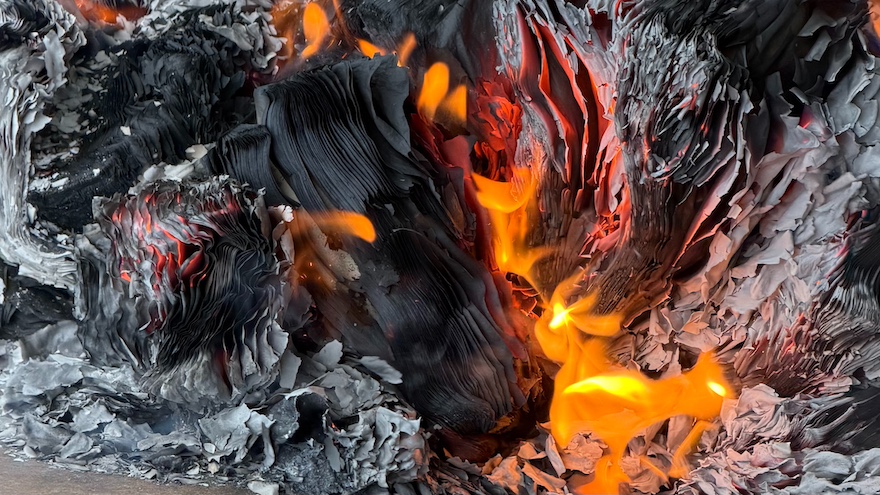
もう一つのアートの矛盾について聞きたいことがあります。取手で本を焼いたときの炎が綺麗でした。残された灰も純粋(ピュア)でした。どんな色の本も、何が書かれている本も、焼かれたら灰色になる。DANNY JINのクリップも、彼の肖像のシーンと本が燃えている様子が往復していて、大事な話を直接歌っているけど、そこに「綺麗」という認識が入ってくる。政治的な作品を作っている作家は、どうしてそこまで「美」にこだわっているのか。
私が日本で見たアートは、一番人気のある印象派も含めて、美(ビューティー)によって脱文脈化され、「あー素敵、綺麗」で回収されてしまう。 最近、アメリカとカナダで見た展覧会には、見苦しいものもたくさんあって、整理されていないことや完成度が低いものがそのまま展示されていました。「あ、これが日本で2年住んでいて見れなかったものだ」という自覚がありました。
こういう「美」の中で、社会性や責任を持つ作品を作るとき、どう思いますか。
藤井
すごくいい質問です。大学に絡めて言うと、フランスである教師と出会ったんです。美大にいたときの面白い授業で、「君たちエリートに教えることはないから、これでも観てなさい」と言って、行くと真っ暗な部屋でいつも映像が流れている。その授業で、いろんな人生を変える映像をたくさん見ました。
例えばジャン・ルーシュの『狂気の主人たち』(1955年)とか。クロード・ランズマンの映画で、ホロコーストを問う代表作『SHOAH』(1985年)ではなく、ランズマンが熱烈なイスラエル国家支持のシオニストであることが分かるレアな映像を観せてくる。『SHOAH』だけ観ていたら見えないことがいろいろと見えてくる。彼、アラン・モロー(Alain Moreau)は刑務所で囚人たちに美術を教えている人なんです。フランスではミシェル・フーコーの『監獄の誕生』(1975年)などの流れもあって、刑務所こそが社会の抑圧が凝縮された場でもあると、ドゥルーズやフーコーのような知識人たちによって、刑務所でいろんな文化運動があったんですよ。その流れで、彼は刑務所で活動していた。僕の中ではいろいろ教えてくれた人なんです。
その彼が僕の作品を見て、「ヒカル、君の撮る映像は美しいね」と言うんですよ。ただのフランス人の嫌味ですよ。「その美しい画角を作ることにどんな意味があるのか」と。そのトゲがぐすっと刺さるわけですよ。今でも抜けてない。大学の教員の一言は、生涯残るんです。
インタビュー 前編 後編 はこちら
・・・・
AL: Images evoke connections, and that is how art works.
DANNY JIN probably told you a lot about the history of Palestine. But many of your works engage with Japan, even though there are also works about Greece and France. When I read the title of this Showcase, Why Look at It?, I thought that although Geidai has international students like myself, the main audience may be Japanese. What do you think about the audience?
HF: Saying that it is directed at Japanese people feels a little off. I do feel a certain responsibility as a Japanese person.
Etymologically, responsibility in English carries the idea of response: answering again, and the possibility of responding to the future. In Japanese, sekinin sounds more backward-looking. To me, it has a more forward-looking sense: a reciprocal process of changing the future.
In my case, I speak Japanese and grew up in Japan, and I’ve gone through life with the enormous advantage of being male. On top of that, I ended up becoming a university professor, so in that sense I’m in a position of power. There is a sekinin (response-ability) that someone like me has to take on. I think about what I can do from that position, and make work from there. Of course, part of the critique is directed toward Japanese people and Japanese history, but the work is never meant only for Japanese people.
For example, The Educational System of an Empire is now in the collection of the National Museum of Modern and Contemporary Art, Korea. For me, that work also carries a response-ability toward Korea’s history under Japanese colonial rule. The question was how I, as a Japanese artist, could build a new relationship with Korean audiences. What I was watching out for then was the exclusionary nationalism that also exists in Korea. I was trying to find a way other than being positioned as a “conscientious Japanese intellectual.”
So when I make work, I’m always looking for forms of expression that can move beyond the framework of the nation. That is the complete opposite of “Global Art Practice.” I want the work to be rooted locally while also moving beyond regional specificity. So I don’t intend the audience to be Japanese. It includes Japanese people, of course international students too. I’m not only thinking about the present moment, but also about ten years from now.
AL: Is the question in the title Why Look at It? addressed to the audience, or to you yourself?
HF: The Showcase is a glass case, and it is displayed in front of the cafeteria. Originally, it was a display case for plates, so it already has its own structure of looking, something like “Look at this!” The title questions that structure itself. It is addressed to the audience, while also putting those conditions into words and reframing them as a question.
AL: So it was made as a separate work from the DANNY JIN video clip, though connected to it.
HF: Yes. The audience can also watch the clip through the QR code.
AL: One word I struggled to understand in Japan was “tōjishasei,” the idea of a stakeholder perspective. With war or natural disasters, too, there is a climate where it is hard to speak unless you are directly involved or affected. There is also pressure to first establish oneself as such, and then engage through art. I feel that this work, too, could be questioned in this regard. What do you think about this idea of tōjishasei that functions almost like a taboo or rule?
HF: For example, Jacques Derrida raises the question, “Who does language belong to?” In the end, it belongs to no one. But everyone has the right to speak about language. That connects to the question, “Who does war belong to?” I think everyone has the right to speak about war as well. The only difference is how each person speaks about it. I think the same applies to earthquakes, disasters, and nuclear accidents.
Of course, we have to listen first to the voices of those directly involved or affected. At the same time, they sometimes say, “No, I’m not that unfortunate. Please listen to people from the areas hit harder by the tsunami.” Then, when you speak to those people, they say, “I didn’t lose my whole family.” Then someone who did lose family members says, “I’m not the real tōjisha. The real tōjisha are the people who were swept away by the tsunami and died with water in their lungs.” If you follow that logic all the way through, in the end, only the dead, who can no longer speak, are the “real tōjisha.”
Then it becomes a question of, “Who is supposed to speak?” That is why the accounts of those directly involved or affected are important. At the same time, to speak is to pass something on and leave a record. It is precisely a sekinin toward the future, a question of response-ability. When you think about it that way, the more different people speak in layered ways, the greater the possibility that the future can change.
AL: In Gaza, journalists, the people whose role is to speak, have been killed in disproportionate numbers. That itself can be seen as an objective, a kind of war against testimony. The books burned this time also belong to testimony, as a discourse of thought. But if we abstract it that far, it could become disrespectful toward the people who actually live there.
HF: Yes, that is a difficult point. Even at this very moment, there are people who have lost their homes, who are suffering from hunger, who are living under extreme conditions. At the same time, what my work is trying to engage with is less that reality itself than a more abstract struggle over “memory” and “historical consciousness.”
What does a society remember, and what does it forget? What kind of history does it share? When that collective imagination is destroyed, people become more likely to justify violence. I think historical consciousness is also a foundation that directs people toward dialogue and negotiation, rather than destruction and killing. But that is a struggle at an extremely high level of abstraction. And it does not directly save the people who are suffering right now. That is one of the limits of art. When thinking about how art engages with society, we have to acknowledge that limit.
There is no hope even if we display the burned books. Still, there remains a perspective that looks directly at this destruction.
AL: It reminds me of a poem. When Alfredo Jaar, the artist who recently exhibited at Tokyo Opera City Art Gallery, came to Geidai for a talk, he quoted Bertolt Brecht: “In the dark times / Will there also be singing? Yes, there will also be singing / About the dark times.”
HF: Yes, that does feel close.
AL: There is another contradiction in art that I want to ask you about. When we burned the books in Toride, the flames were beautiful. The ash that remained was also pure. No matter what color the books were, or what was written in them, once they were burned, they all became gray. DANNY JIN’s video also moves back and forth between scenes of his portrait and the books burning. He is singing directly about something important, but the perception of “beauty” still enters. Why are you so concerned with “beauty” when making such political work?
The art I have seen in Japan, including the most popular Impressionism, often gets decontextualized through beauty and reduced to “Oh, how lovely, beautiful.” Recently, in exhibitions I saw in the United States and Canada, there were many things that were hard to look at. Things that were unorganized or not polished were shown as they were. I realized, “Ah, this is what I hadn’t been able to see during my two years living in Japan.”
What do you think about making work with serious social responsibility within this “beauty”?
HF: That’s a very good question. To connect it to the university, in France I met a teacher in this interesting class at the art school. He would say, “I have nothing to teach you elites, so just watch this,” and whenever we went, there would always be a video playing in a completely dark room. In that class, I saw many videos that changed my life.
For example, Jean Rouch’s The Mad Masters (1955). With Claude Lanzmann, instead of showing Shoah (1985), his major work on the Holocaust, he would show us rare footage that made clear how passionately Lanzmann supported the State of Israel as a Zionist. You begin to see things that you don’t notice if you only watch Shoah. That teacher, Alain Moreau, also taught art to prisoners. In France, through the influence of Michel Foucault’s Discipline and Punish (1975), there were many cultural movements in prison, led by intellectuals like Deleuze and Foucault, since prison is precisely where social oppression is condensed. Moreau worked in that context. In my mind, he was someone who taught me many important things.
That same teacher later looked at my work and said, “Hikaru, the videos you shoot are so beautiful.” Pure French sarcasm. What he meant was, “What is the point of making such beautiful compositions?” That thorn went deep into me, and it still hasn’t come out. A single comment from your professor can stay with you for life.
Click Part1 / Part3 of The Interview
【SHOWCASE UENO】
#18 藤井光 / Hikaru Fujii インタビュー Interview(JP/EN)|リ・アンチー / Anqi Li
展示情報 Exhibition Information
English follows,
インタビュー( 前編 中編 後編 )
・・・
3、未来に向けての責任(レスポンサビリティ)
アンチー
イメージによっていろいろ想起される、まさにアートじゃないですか。
DANNY JINからパレスチナの歴史についていろいろ聞いたでしょう。でも藤井先生の作品はギリシャやフランスも含めつつ、日本に関して作っているものが多いじゃないですか。このショーケースのタイトル『なぜ、それを観るのか?』を読んで、芸大には私みたいな国際学生もいるけれど、メインのオーディエンスは日本人になるんですかね。観客についてどう思いますか。
藤井
日本人に向けてというのはちょっとずれるかな。日本人としての、ある種の「責任」を感じますけどね。
責任は英語でレスポンシビリティ(responsibility)で、語源的にはもう一度答える、未来に対して応える可能性を秘めた言葉ですよね。でも日本語で責任と言うと後ろ向きに聞こえるけど、もっと前向きな、未来を相互的に変えていく意味合いがある。
自分の場合、日本語も喋って日本で育ったし、男性という圧倒的な下駄を履いて生きてきた。さらに大学の先生になっちゃって、そういう意味で強者なんですよ。そういう自分が引き受ける責任(レスポンサビリティ response-ability)があって、何ができるか、考えて作る。もちろん批評性が日本人や日本の歴史に向く部分もあるけど、それは決して日本人に対して見せるだけではない。
例えばこの作品、『帝国の教育制度』は、韓国の国立現代美術館に収蔵されているけれど、日本が植民地として抑圧してきた韓国の歴史に対するレスポンサビリティでもあります。韓国の観衆と自分がどう新たな関係を築いていくか。そのときに気をつけていたのは、韓国にもある排他的なナショナリズムです。「良心的な日本の文化人」として受け入れられるっていうやり方ではない方法を探っていました。
だから作品を作るときには、国(ネーション)という枠を超える表現を模索しています。それは、「グローバル・アート・プラクティス」とは真逆で、ローカルに根差しながら地域性を越えていく作品にしたい。だから観客は日本人っていう設定は自分にはない。日本人も含む、もちろん国際学生も含むという感じ。時代も今だけじゃなくて、十年後も考えながら作っています。
アンチー
タイトルの『なぜ、それを観るのか?』という問いは観客に投げているのか、もしくは藤井先生自身に?
藤井
ショーケースはガラスケースで、しかも食堂の前に展示されている。本来はお皿が並ぶディスプレイで、それ自体が作り出す視線の構造がある。「見て!」というような。その構造自体を問うタイトルにしているので、観客に投げかけると同時に、その条件を言語化して、問いとして立て直しました。
アンチー
DANNY JINとのビデオクリップとは別の作品として作られていて、関連しているんですね。
藤井
QRコードでクリップも見られます。
4、「当事者性」と今でも抜けていない「美」のとげ
アンチー
私が日本でなかなか理解できなかったのは、「当事者性」という言葉です。戦争や自然災害に関しても、当事者でなければ発言しづらい空気や、まず当事者であろうとする姿勢が求められ、そのうえでアートとして関わるという流れがあります。今回の作品も、当事者性が問われる可能性のあるものだと感じています。このタブー、あるいは一種のルールのように機能している「当事者性」について、どのように考えていますか。
藤井
例えばジャック・デリダが「言語は誰のものか」という問いを立てる。結局それは誰のものでもない。だけど、言語について誰もが語る権利はある。それは「戦争は誰のものか」という問いにも繋がってくる。戦争についても誰もが語る権利はあると僕は思うんですね。それぞれの語り方が違うだけ。それは震災や原発事故についても言えると思う。
でも、当事者の声は、第一に耳を傾けていかなければいけないと思います。ただ一方で、当事者の人たちが「いや、私はそこまで不幸ではないから、もっと津波被災地域の人たちに聞いてください」と言うことがある。さらに、そうした人たちに話を聞くと、「私は家族全員を亡くしてはいないので」と言う。すると今度は、家族を亡くした人が「本当の当事者は私ではない。津波に流され、肺に水を入れて亡くなった人こそ本当の当事者だ」と語る。その論理を突き詰めていくと、最終的には、もう何も語ることのできない死者だけが「本当の当事者」になってしまう。
「じゃあ誰が語るんだ」という話になる。だから当事者の語りも本当に大事なんだけれども、一方で、「語る」とは「伝える、残す」、まさに未来への責任。未来応答性の問題で、それを考えると、様々な人が複層的に語っていった方が、結果的には未来が変わっていく可能性は高まる。
アンチー
ガザでも、記者という「語る役割」の人たちが最も多く殺されている。それ自体が目的であり、ある種の「語り」に対する戦争とも言えるかも知りません。今回焼かれた本も、知のディスコースとして「語り」の範囲に入るでしょう。ただ、そこまで抽象化してしまうと、そこに住んでいる人たちに対してディスリスペクトにもなるかも知りません。
藤井
確かに難しいところですよね。今この時点でも、家を失い、飢餓に苦しみ、極限状態にいる人たちがいる。一方で、私の作品が表現において関与しようとしているのは、その現実そのものというより、むしろ「記憶」や「歴史認識」をめぐる、より抽象的な闘争になっている。
ある社会が、何を記憶し、何を忘却するのか。どのような歴史を共有するのか。 そうした集合的な想像力が壊されると、人間は暴力を正当化しやすくなる。歴史認識とは、破壊や殺害ではなく、対話や交渉へと人々を向かわせるための基盤でもあると思うんです。でも、それは極めて抽象度の高い闘争です。そして、そのことが、今まさに苦しんでいる人たちを直接救うわけではない。そこは芸術の一つの限界です。芸術が社会にエンゲージすることを考えたとき、その限界は認めざるを得ない。
焼かれた本をディスプレイしても何の希望もない。それでも破壊をまなざすという視点は残る。
アンチー
ある詩を思い出しました。東京オペラシティ アートギャラリーで展覧会をしたアーティスト、アルフレド・ジャーが芸大に来てトークをしたときに、彼が引用していたブレヒトの詩です。「暗い時代にも歌は歌われるだろうか? ああ、歌われるだろう。暗い時代についての歌が。」
藤井
うん、確かに近いかもね。
アンチー
もう一つのアートの矛盾について聞きたいことがあります。取手で本を焼いたときの炎が綺麗でした。残された灰も純粋(ピュア)でした。どんな色の本も、何が書かれている本も、焼かれたら灰色になる。DANNY JINのクリップも、彼の肖像のシーンと本が燃えている様子が往復していて、大事な話を直接歌っているけど、そこに「綺麗」という認識が入ってくる。政治的な作品を作っている作家は、どうしてそこまで「美」にこだわっているのか。
私が日本で見たアートは、一番人気のある印象派も含めて、美(ビューティー)によって脱文脈化され、「あー素敵、綺麗」で回収されてしまう。 最近、アメリカとカナダで見た展覧会には、見苦しいものもたくさんあって、整理されていないことや完成度が低いものがそのまま展示されていました。「あ、これが日本で2年住んでいて見れなかったものだ」という自覚がありました。
こういう「美」の中で、社会性や責任を持つ作品を作るとき、どう思いますか。
藤井
すごくいい質問です。大学に絡めて言うと、フランスである教師と出会ったんです。美大にいたときの面白い授業で、「君たちエリートに教えることはないから、これでも観てなさい」と言って、行くと真っ暗な部屋でいつも映像が流れている。その授業で、いろんな人生を変える映像をたくさん見ました。
例えばジャン・ルーシュの『狂気の主人たち』(1955年)とか。クロード・ランズマンの映画で、ホロコーストを問う代表作『SHOAH』(1985年)ではなく、ランズマンが熱烈なイスラエル国家支持のシオニストであることが分かるレアな映像を観せてくる。『SHOAH』だけ観ていたら見えないことがいろいろと見えてくる。彼、アラン・モロー(Alain Moreau)は刑務所で囚人たちに美術を教えている人なんです。フランスではミシェル・フーコーの『監獄の誕生』(1975年)などの流れもあって、刑務所こそが社会の抑圧が凝縮された場でもあると、ドゥルーズやフーコーのような知識人たちによって、刑務所でいろんな文化運動があったんですよ。その流れで、彼は刑務所で活動していた。僕の中ではいろいろ教えてくれた人なんです。
その彼が僕の作品を見て、「ヒカル、君の撮る映像は美しいね」と言うんですよ。ただのフランス人の嫌味ですよ。「その美しい画角を作ることにどんな意味があるのか」と。そのトゲがぐすっと刺さるわけですよ。今でも抜けてない。大学の教員の一言は、生涯残るんです。
インタビュー 前編 後編 はこちら
・・・・
3. Response-ability toward the future
AL: Images evoke connections, and that is how art works.
DANNY JIN probably told you a lot about the history of Palestine. But many of your works engage with Japan, even though there are also works about Greece and France. When I read the title of this Showcase, Why Look at It?, I thought that although Geidai has international students like myself, the main audience may be Japanese. What do you think about the audience?
HF: Saying that it is directed at Japanese people feels a little off. I do feel a certain responsibility as a Japanese person.
Etymologically, responsibility in English carries the idea of response: answering again, and the possibility of responding to the future. In Japanese, sekinin sounds more backward-looking. To me, it has a more forward-looking sense: a reciprocal process of changing the future.
In my case, I speak Japanese and grew up in Japan, and I’ve gone through life with the enormous advantage of being male. On top of that, I ended up becoming a university professor, so in that sense I’m in a position of power. There is a sekinin (response-ability) that someone like me has to take on. I think about what I can do from that position, and make work from there. Of course, part of the critique is directed toward Japanese people and Japanese history, but the work is never meant only for Japanese people.
For example, The Educational System of an Empire is now in the collection of the National Museum of Modern and Contemporary Art, Korea. For me, that work also carries a response-ability toward Korea’s history under Japanese colonial rule. The question was how I, as a Japanese artist, could build a new relationship with Korean audiences. What I was watching out for then was the exclusionary nationalism that also exists in Korea. I was trying to find a way other than being positioned as a “conscientious Japanese intellectual.”
So when I make work, I’m always looking for forms of expression that can move beyond the framework of the nation. That is the complete opposite of “Global Art Practice.” I want the work to be rooted locally while also moving beyond regional specificity. So I don’t intend the audience to be Japanese. It includes Japanese people, of course international students too. I’m not only thinking about the present moment, but also about ten years from now.
AL: Is the question in the title Why Look at It? addressed to the audience, or to you yourself?
HF: The Showcase is a glass case, and it is displayed in front of the cafeteria. Originally, it was a display case for plates, so it already has its own structure of looking, something like “Look at this!” The title questions that structure itself. It is addressed to the audience, while also putting those conditions into words and reframing them as a question.
AL: So it was made as a separate work from the DANNY JIN video clip, though connected to it.
HF: Yes. The audience can also watch the clip through the QR code.
4. “Tōjishasei” and the stubborn thorn of “beauty”
AL: One word I struggled to understand in Japan was “tōjishasei,” the idea of a stakeholder perspective. With war or natural disasters, too, there is a climate where it is hard to speak unless you are directly involved or affected. There is also pressure to first establish oneself as such, and then engage through art. I feel that this work, too, could be questioned in this regard. What do you think about this idea of tōjishasei that functions almost like a taboo or rule?
HF: For example, Jacques Derrida raises the question, “Who does language belong to?” In the end, it belongs to no one. But everyone has the right to speak about language. That connects to the question, “Who does war belong to?” I think everyone has the right to speak about war as well. The only difference is how each person speaks about it. I think the same applies to earthquakes, disasters, and nuclear accidents.
Of course, we have to listen first to the voices of those directly involved or affected. At the same time, they sometimes say, “No, I’m not that unfortunate. Please listen to people from the areas hit harder by the tsunami.” Then, when you speak to those people, they say, “I didn’t lose my whole family.” Then someone who did lose family members says, “I’m not the real tōjisha. The real tōjisha are the people who were swept away by the tsunami and died with water in their lungs.” If you follow that logic all the way through, in the end, only the dead, who can no longer speak, are the “real tōjisha.”
Then it becomes a question of, “Who is supposed to speak?” That is why the accounts of those directly involved or affected are important. At the same time, to speak is to pass something on and leave a record. It is precisely a sekinin toward the future, a question of response-ability. When you think about it that way, the more different people speak in layered ways, the greater the possibility that the future can change.
AL: In Gaza, journalists, the people whose role is to speak, have been killed in disproportionate numbers. That itself can be seen as an objective, a kind of war against testimony. The books burned this time also belong to testimony, as a discourse of thought. But if we abstract it that far, it could become disrespectful toward the people who actually live there.
HF: Yes, that is a difficult point. Even at this very moment, there are people who have lost their homes, who are suffering from hunger, who are living under extreme conditions. At the same time, what my work is trying to engage with is less that reality itself than a more abstract struggle over “memory” and “historical consciousness.”
What does a society remember, and what does it forget? What kind of history does it share? When that collective imagination is destroyed, people become more likely to justify violence. I think historical consciousness is also a foundation that directs people toward dialogue and negotiation, rather than destruction and killing. But that is a struggle at an extremely high level of abstraction. And it does not directly save the people who are suffering right now. That is one of the limits of art. When thinking about how art engages with society, we have to acknowledge that limit.
There is no hope even if we display the burned books. Still, there remains a perspective that looks directly at this destruction.
AL: It reminds me of a poem. When Alfredo Jaar, the artist who recently exhibited at Tokyo Opera City Art Gallery, came to Geidai for a talk, he quoted Bertolt Brecht: “In the dark times / Will there also be singing? Yes, there will also be singing / About the dark times.”
HF: Yes, that does feel close.
AL: There is another contradiction in art that I want to ask you about. When we burned the books in Toride, the flames were beautiful. The ash that remained was also pure. No matter what color the books were, or what was written in them, once they were burned, they all became gray. DANNY JIN’s video also moves back and forth between scenes of his portrait and the books burning. He is singing directly about something important, but the perception of “beauty” still enters. Why are you so concerned with “beauty” when making such political work?
The art I have seen in Japan, including the most popular Impressionism, often gets decontextualized through beauty and reduced to “Oh, how lovely, beautiful.” Recently, in exhibitions I saw in the United States and Canada, there were many things that were hard to look at. Things that were unorganized or not polished were shown as they were. I realized, “Ah, this is what I hadn’t been able to see during my two years living in Japan.”
What do you think about making work with serious social responsibility within this “beauty”?
HF: That’s a very good question. To connect it to the university, in France I met a teacher in this interesting class at the art school. He would say, “I have nothing to teach you elites, so just watch this,” and whenever we went, there would always be a video playing in a completely dark room. In that class, I saw many videos that changed my life.
For example, Jean Rouch’s The Mad Masters (1955). With Claude Lanzmann, instead of showing Shoah (1985), his major work on the Holocaust, he would show us rare footage that made clear how passionately Lanzmann supported the State of Israel as a Zionist. You begin to see things that you don’t notice if you only watch Shoah. That teacher, Alain Moreau, also taught art to prisoners. In France, through the influence of Michel Foucault’s Discipline and Punish (1975), there were many cultural movements in prison, led by intellectuals like Deleuze and Foucault, since prison is precisely where social oppression is condensed. Moreau worked in that context. In my mind, he was someone who taught me many important things.
That same teacher later looked at my work and said, “Hikaru, the videos you shoot are so beautiful.” Pure French sarcasm. What he meant was, “What is the point of making such beautiful compositions?” That thorn went deep into me, and it still hasn’t come out. A single comment from your professor can stay with you for life.
Click Part1 / Part3 of The Interview