ショーケース 上野
2026.06.12 UP
Part3-後編【SHOWCASE UENO】#18 藤井光 / Hikaru Fujii インタビュー Interview(JP/EN)|リ・アンチー / Anqi Li
Part3-後編
【SHOWCASE UENO】
#18 藤井光 / Hikaru Fujii インタビュー Interview(JP/EN)|リ・アンチー / Anqi Li
展示情報 Exhibition Information
English follows,
インタビュー( 前編 中編 後編 )
・・・
アンチー
私もそう思いますよ。綺麗な「先生が喜ぶ絵」と一緒です。それを求めてないからフランスに行ったんじゃないですか。
藤井
そのトゲがリフレクションを促すので、アランに出会えて本当によかったと思う。ただ、自分はその後、社会運動の現場で映像を制作していて、そのときに大事になってくるのは、美ではなく「スタンダード」であること。つまり、映像のクオリティを標準レベルにすると、人はその映像を観るわけ。
「今日のエステティック」といえばいいのかな。毎日、ご飯のように消費している映像。その中で、「これ美味しくない」「これコンビニの味」といった判断を映像に対してもしている。「スタンダード」に達していない映像は、一瞬で弾かれる。それだと社会運動の映像としては意味がない。DANNY JINのビデオクリップに映っているのは「美」ではなく、Netflixの映画を作っている人たちと同じカメラを使って撮った今日のスタンダードなものの一つだと思います。
アランは、もう亡くなりましたけど、こう反論するかもしれない。「それは美じゃない。スタンダードな画角にすぎない」と。
少し哲学的な話をすると、古代ギリシャにおいて、社会の中で力を持たない「デモス」と呼ばれる人々は、声をあげても、統治者から「何を言っているかわからない、たわごとだ」と見なされていました。そのため、デモスの要求を翻訳して統治者に伝える役割を持つ人々が現れます。ランシエールが『民主主義への憎悪』(2005年)で述べているように、そこからデモクラシー(民主主義)が生まれる。
きっと僕は、この「たわごと」とされる我々民衆の言葉を、資本主義的「スタンダード」の言語に合わせて、その声が広がるよう試みてきた。運動の中でその必要性を感じながら組み立ててきた。
アンチー
キュレーターの立場からは理解できます。美はアートへの入口として人を引きつける道具でもあります。ただ、スタンダードを意識すると、それを目指さざるを得ないというジレンマが生まれます。例えば制作のうち30%をスタンダードへの対応、残り70%をコンセプトに。経験のある人はそこまでしないかもしれませんが、例えば先端やGAPの学生は、もともと違う考えを持って芸大に来たのに、スタンダードに合わせるために努力していて、その結果、少し重心がずれているように見えます。
実際、卒展では、完成度は高いものの、どこか「どうでもいい」感じがあり、後味が残らない作品も多い。芸大が一種のスタンダードを教え込んでいるのではないかとも感じます。そうした中で、先生としてGAPでどう教えるのか。かつての先生の言葉を今でも覚えていて、それに対する反論を考えながら教師になった。芸大で自分が欲しかった先生になると思いますか。
藤井
言われて「はっ」と思ったんだけど、確かにスタンダードを学生に教えている。それがあるから表現が遠くまで届くという側面もある。例えば論文を書くために、自分が文献を紹介するのは、ある種のスタンダードとして、国境を越えて人と通じ合うためのツールとしての理論的レファレンスを教えている自分もいる。
もちろんスタンダードというのは、時代によって変わる。例えば、脱西洋中心のポストコロニアルとエコフェミニズムを中心とした思想が、今のスタンダードです。その思想は、国境を越えていくんです。例えばロバート・スミッソンの『スパイラル・ジェッティ』(1970年)が設置された場所には先住民の物語があった。にもかかわらず、現代美術の神話をその上に一方的に上書きした。当時の作家はそうした意識を持たずに制作していたとしても、今日その作品を語るときには、そこに住んでいた先住民や土地の所有をめぐる問題を抜きにして語ることはできない。そういう視点こそが、今のスタンダードだと思います。
といっても、「スタンダード」は難しいね。凶暴な言葉だよね、やっぱり。
アンチー
私から見ると、スタンダードは現代アートが挑戦していく対象で、理論は更新され続けている。教え込むより、「みんなこう言っているけど、どう思う?」と問いかける形がいいと思う。
一方で、ポストコロニアルやエコフェミニズムなどのスタンダード理論に対して、学生が飽きを感じている印象がある。絶対的なものとして教えられてきたことで関心が閉じていき、その結果、知識に十分触れないまま、自分の作りたいものだけに集中している人が多いように見える。
藤井
だから、教師がある種の無知に自覚的になり、学生と一緒に問いを探る「どう思う?」という形はいいと思うし、自分もエコフェミニズムやポストコロニアルを「スタンダード」として押し付けない。問いを開くことは意識している。
ただ一方で、社会の中で表現がどこまで許されるかという「限界ライン」が常にあって、それは地政学的にも変動し、後退することもある。表現の領域は有機的で、「昨日はここまで表現できたのに、明日はもうできない」みたいな。自分はアーティストとしてその限界ラインにいることが多く、よく展覧会で検閲に遭う。僕が大学にいる理由って、アーティストだからで、その役割は、その限界ラインをカナリアのようにリアルタイムで学生に知らせることでもある。
ポストコロニアルやエコフェミニズムも、今政治的に攻撃されている領域で、先月滞在していたアメリカではブラックやクイアの表現も含めて消されている状況もあるし、簡単に語れるテーマではない。だから「スタンダード」と言っても、社会のスタンダードではない。
学生が「聞き飽きた」と言う気持ちもわかるが、排外的言説やナショナリズムが強まる現在だからこそ、植民地主義の歴史やデコロニアルな視点について、改めて考える必要があるのではないかと思います。
アンチー
社会とアートの関係は見えにくくなり、「自分は当事者ではない」と感じることが普通になっている。これは芸大の学生に限らず日本社会全体に見られ、他者ももはや「人間」ではなく「外人」や「インバウンド」としてしか捉えられていない。
藤井
今の話で言えば、ポストコロニアルは現代美術ではスタンダードな語りになっている。今年のベネチア・ビエンナーレも、その視点がなければイスラエルもロシアも「どうぞどうぞ、みんなでやりましょう」となるが、そうはならない。
一方で、大学での個々の表現は、そうした世界とは距離があり、より内的な表現にとどまっている。それを「スタンダード」への反発だけで説明することはできない。制作には、手や身体を通した行為、書くこと、読むこと、調べることといった複数の方法論がある。
例えばポストコロニアルについても、サイードのテキストに至るまでには、参照されている思想や歴史への接続があり、さらにその先にも多様な議論が連なっている。日本の美術教育では、そういう思索の回路が十分に作られていない。その状況では、「この思想に飽きた」という判断自体が成立していないと思うんです。
「読みなさい」と言われることへの抵抗とは別に、内向きの表現が生まれる背景には別の要因がある。経済や社会システム、法といった構造が影響している。例えば中国からの留学生のケースでは、検閲が現実に作用している。作品を発表することでメインランドにいる家族に影響が及び、卒展に本名を出せない状況もある。そのような経験は他の学生にも伝播し、社会的・政治的な表現を避ける方向へと働く。これは教育の問題というより、より大きなシステムの中で起きている。
別の例では、市場の動きに応じて表現が変化することもある。油画科の先生から聞いたけど、「学生がいきなり表現を変えてきた」って。アートフェアで評価された同世代の作品に影響を受けて、制作の方向がガラッと変わる。そこでの選択は、制作を継続するための「生」の条件とも関係している。
こうした複数の要因の中で、表現が内側にとどまることにはそれぞれ理由があって、単純に批判はできないと思う。ただ、自分としては、学生たちに求められれば、その表現が地域や国を越えるものを探究していきたい。
藤井
アーティストは今、国内だけでは生きていけない。中小企業でさえ国境を越えたネットワークを必要としている。アーティストも国内の芸術祭やギャラリーだけでは生きていけない。自分の収入を考えても海外の美術館の方が圧倒的で、日本のアートフィーは低すぎて無理です。だから日本でも活動してほしいが、それだけでは厳しいという現実もある。
アンチー
それを踏まえて、越境しなければならない知的な理由は何でしょう?
藤井
四日前にシンガポール国立美術館でシンポジウムがあって、アーカイブについて議論したんですよ。そこには美術関係者だけでなく、フィリピンの原住民アクティビストも来ていた。フィリピンでは森の自然を守る中で、2016年以降1500人くらいが政府に殺されている。ミャンマーの人も来ていたし、レバノンからは爆撃の中で地下にアーカイブを作るという報告もあった。
社会を良くしようと信じて活動している人たちが世の中にいるんですよ。本当に。そのネットワークが僕にとってのアートで、そういう人たちがコンテンポラリーアートのもとに集まって活動しているんです。だからアートは、世界を変えようと、新しい未来を作ろうとする人たちのネットワークです。そこに美の問題とか、より表層的でテクニカルな形式や表現の話が入ってくる。
GAPは美大出身だけではなくて、社会学を学んだ学生とかいろんな背景の人が来る。一番重要なのはリサーチクエスチョンで、その問いから表現が生まれてくる。それをとにかく応援団としてサポートする、という感じですね。
アンチー
作品制作で先生が監督という役割を果たすのは、その現場やそのときに限られている。「この場では私の言うことを聞いて、一緒に作品を作る」という関係になる。大学ではもっと長い時間で、路上で学生と出会えばその瞬間で先生になる。だから簡単に切り離せる役割ではない。今言っていたのは、学生たちのリサーチクエスチョンを応援する立場ですね。
藤井
だと思いますけどね。そのリサーチクエスチョンが、じゃあ東京藝術大学の学生みんなにあるかといったら、それはまた別の話。僕はリサーチクエスチョンのある学生が周りにいっぱいいるので、そういう意味では幸せです。
アンチー
社会問題や政治的なアートを作ってきた人は、大学に入ると「投降した」と思われるのか。それでもサイードの本を見せるなど、先生だからこそできることがある。
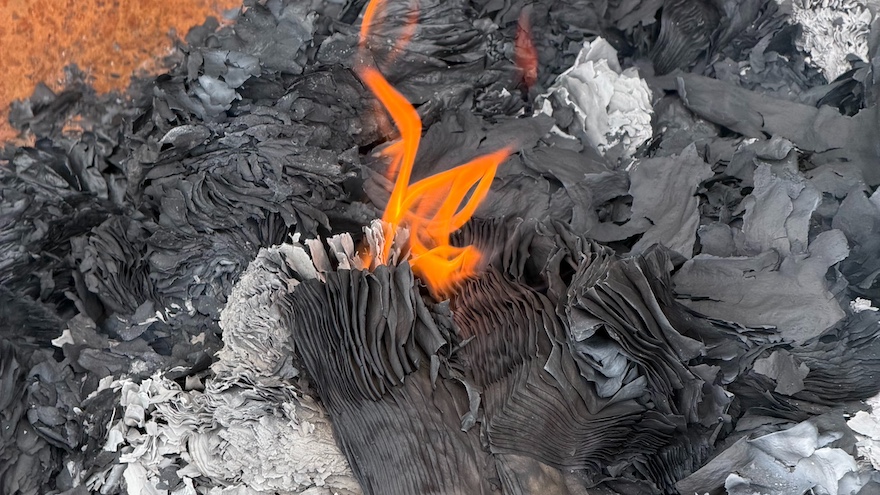
今回の作品に戻ると、なぜ本が焼けた後を見せるのか。自分は本というものを信頼しすぎているのかもしれない。本を焼いた後にどうするのか、その知が失われ、無視された後に何ができるのかという問題が残る。
『藤井光〈日本の戦争美術 1946〉展を再演する』(2025年)で話されていたように、日本が硬い土なら日本国憲法はふわふわしている。でも今はそれさえ危うく、武器の輸出などに一歩踏み込んでいる。その中で今回は、このショーケースのためにもう一度本を焼いた。
藤井
頼まれたからね(笑)。
アンチー
それでももう一回作ることによって、この知やスタンダード、これまで私たちが当たり前に言えてきたことがなくなった後に、何ができるのか。
藤井
分からない。絶望...
アンチー
絶望したくないから、
藤井
今回の展示では、本が全部焼けているわけではなくて、ページを開いて見せているでしょ。どのページを開くかによって、いろいろ変わってくると思う。サイードの『パレスチナとは何か』の日本語版を持ってきたけど、どのページを開くか、キュレーターとして何か決める?
アンチー
いやいや、それはキュレーターが決めることじゃない。
藤井
いやいやいや。どのページを開くかによって、多分それが希望にもなれば、と思って。
アンチー
じゃあオプションとして。
藤井
前回の取手の展示ではこのページを開いていたのね。ドイツに来た中東の移民たちの身体検査で、全員を裸にしている。この人たちが労働者として、ドイツのインフラを作ってきた人たちです。
アンチー
しかも、一人ひとりではなく、みんなの前で。
藤井
集団でね。コロニアルな関係そのものです。こういう写真を開くことによって、違うことが連想されたりする。例えば、これは?
アンチー
それはちょっと甘いですかね。
藤井
それでは作品をインストールしながら考えていきましょう。
アンチー
私が日本で、芸大で、GAで勉強してきた中で浮かんできたさまざまな質問に答えてくれて、ありがとうございました。お疲れ様です。
藤井
鋭い質問がいろいろあって楽しかったです。
(2026年5月1日 東京藝術大学 上野校舎 国際交流棟)
インタビュー 前編 中編 はこちらから
・・・・
AL: I think so too. It feels the same as making a beautiful picture the teacher would like. I thought you went to France because that wasn’t what you wanted.
HF: That thorn pushed me to reflect, so I’m truly glad I met Alain. But later, when I was making videos on the sites of social movements, what mattered was not beauty but “standard.” If the video quality reaches a certain standard, people will watch it.
Maybe we could call it “the aesthetic of today.” The visual content people consume every day, like food. People judge it in the same way: “This doesn’t taste good,” “This tastes like convenience-store food.” If a video doesn’t reach that standard, it gets rejected instantly. Then it has no meaning as a video for a social movement. What appears in DANNY JIN’s video clip is not “beauty.” I think it is one example of today’s standard, shot with the same camera used by people making Netflix films.
Alain has passed away, but I would have responded: “That isn’t beauty. It’s just a standard composition.”
Speaking philosophically, in ancient Greece there were people called the “demos” who had no power in society. Even when they raised their voices, rulers would say, “I don’t know what they’re talking about; it’s nonsense.” So people emerged whose role was to translate the demands of the demos and convey them to the rulers. As Rancière writes in Hatred of Democracy (2005), democracy emerged from there.
I was probably trying to take the words of us, the people, words often dismissed as “nonsense,” and align them with the language of capitalist “standards” so that those voices can spread. I built this approach while feeling that necessity within movements.
AL: As a curator, I understand that. Beauty can function as one of the entry points into art, a tool that draws people in. But once you become aware of standards, you face the dilemma of having to aim for them. Maybe 30% of the production goes toward meeting the standard, and the remaining 70% goes toward working through the concept. More experienced artists may not need that much, but students in Intermedia Art or GAP, for instance, who initially came to Geidai with different ideas, now have to work hard to fit the standard. As a result, their focus could shift.
At the graduation exhibition, I saw many highly polished works with an air of indifference, and works that left little aftertaste. I sometimes feel that Geidai instills a certain standard. How do you teach in GAP? You still remember the words of your late professor, and while thinking through a response, you became a professor yourself. Do you think you can become the kind of professor you would have wanted at Geidai?
HF: When you said that, I thought, “Ah,” and realized that I do teach students standards. There’s also the point that art can travel farther because of that. For example, when I introduce texts for students to write papers, part of me is teaching theoretical references as a kind of standard, as tools for them to communicate with people across borders.
Of course, standards change over time. Today, for example, the standard is shaped by postcolonial and ecofeminist thinking that decenters the West. Those ideas travel across national borders. Take Robert Smithson’s Spiral Jetty (1970). The site where it was made already had Indigenous stories. And yet, the myth of contemporary art was arbitrarily written over them. Even if artists at the time made the work without such awareness, we cannot talk about it today without addressing the Indigenous people who lived there and the questions around land ownership. I think that kind of perspective is today’s standard.
That said, “standard” is difficult. It really is a violent word.
AL: From my perspective, standards are something contemporary art is supposed to challenge, and theory is constantly being updated. Rather than instilling them, I think it is better to ask, “People are saying this, but what do you think?”
At the same time, I get the impression that students are tired of standard theories like postcolonialism and ecofeminism. When they are taught as absolutes, students lose interest. As a result, many of them seem to focus only on what they want to make before really engaging with the theories.
HF: So I think it is good for teachers to be aware of their own ignorance, and to search for questions together with students by asking, “What do you think?” I never impose ecofeminism or postcolonialism as “standards.” I try to keep the questions open.
At the same time, there is always a “boundary line” for how far art is allowed in society. That line shifts geopolitically, and it can also move backward. It’s organic: something that could be said yesterday may no longer be possible tomorrow. As an artist, I often find myself on that line, and I often face censorship in exhibitions. The reason I am at the university is that I am an artist, and my role is to let students know, in real time, where that line is, like a canary in a coal mine.
Postcolonialism and ecofeminism are also fields that are under political attack right now. In the United States, where I was staying last month, Black and queer voices were being erased, so these are not easy themes to talk about. So even if we call them “standards,” they are not society’s standards.
I understand why students say they are tired of hearing about them. But precisely now, when xenophobic discourse and nationalism are becoming stronger, I think we need to think again about the history of colonialism and decolonial perspectives.
AL:
It’s becoming harder to see the connection between society and art, while it has become normal to feel, “It’s none of my business (I’m not tōjisha).” This is not limited to Geidai students; it can be seen across Japanese society, where others are no longer seen as human beings but as “gaijin” or “inbound.”
HF: In relation to what you just said, postcolonialism has become a standard discourse in contemporary art. At this year’s Venice Biennale, too, without that perspective, Israel and Russia would simply be welcomed with “Please, join us, let’s all do this together.” But that is not what is happening.
At the same time, individual practice inside the university is distant from that world, and tends to remain internal. That cannot be explained only as resistance against “standards.” In making work, there are multiple methodologies: actions through the hands and body, writing, reading, researching.
For example, even with postcolonialism, before you arrive at Said’s texts, there are connections to the ideas and histories they reference, and beyond that, many different debates continue. In Japanese art education, those circuits of thought have not been sufficiently built. Under these conditions, I don’t think the judgment “I’m tired of this” really holds.
Resistance to being told “read this” is one thing. Aside from that, there are other factors behind why inward-looking work emerges: the economy, social systems, and law. In the case of international students from China, for example, censorship operates as a real force. Presenting work can affect family members on the mainland, and there are situations where students cannot use their real names in the graduation exhibition. Those experiences spread to other students as well, and push them away from social or political work. This is less a problem of education than something happening within a larger system.
There is also the market. I heard from a professor in the Oil Painting Department that students suddenly changed their work. After seeing works by artists of their own generation gain recognition at art fairs, their direction changed completely. Those choices are also connected to the conditions of survival, to whether they can keep making work.
So there are different reasons why some work turns inward, and I cannot simply criticize that. As for me, if students ask for it, I hope to explore with them how their work might move beyond regions and nations.
HF: Artists today cannot survive only domestically in Japan. Even small and medium-sized companies need transnational networks. Artists, too, cannot survive only through domestic art festivals and galleries. Looking at my own income, overseas museums account for far more, and art fees in Japan are too low. It just doesn’t work. So even though I want to work in Japan, there is also the reality that Japan alone is difficult.
AL: Given that, what is the intellectual reason for crossing borders?
HF: Four days ago, there was a symposium at the National Gallery Singapore, where we discussed archives. It wasn’t only art people. Indigenous activists from the Philippines were there too. In the Philippines, around 1,500 people have been killed by the government since 2016 while trying to protect forests and nature. People from Myanmar were there as well, and someone from Lebanon reported on building an archive underground during bombings.
There really are people in the world who believe in working to make society better. For me, that network is art. People like that gather under contemporary art and carry out their work. Art is a network of people trying to change the world and create a new future. More surface-level, technical questions of form and expression, such as beauty, come after that.
GAP has students from many backgrounds, not only from art school but also from sociology and other fields. The most important thing is the research question, and art stems from that. My role is to support that, like a cheering squad.
AL: When you work as a production director, your role is limited to the site and the moment. The relationship is, “Follow me here, and let’s make the work together.” At the university, the time span is much longer. If you meet a student on the street, you become their teacher in that moment too. The role cannot be easily separated. What you described just now is the position of supporting students’ research questions.
HF: I think so. Whether every single student at Tokyo University of the Arts has a research question is another matter. I am surrounded by many students who do have research questions, so in that sense I am happy.
AL: When someone who has made social and political art enters the university, people might say they have “surrendered.” Even so, there are things you can do because you are a professor, such as showing Said’s book.
Returning to this work, why show books after they have been burned? I may trust books too much. What do we do after books have been burned? After the critical thought has been lost and ignored, the question of what can be done remains.
As you said in Hikaru Fujii: A Reenactment of Japanese War Art 1946 (2025), if Japan is hard ground, at least the Constitution of Japan is soft and gentle. But even that is in danger now, and Japan has moved further into things like arms exports. In that situation, you burned books again for this Showcase.
HF: Because I was asked to. (laughs)
AL: Even so, by doing it again, the question becomes: after this body of thought, these standards, and the things we were able to take for granted disappear, what can we do?
HF: I don’t know. Despair...
AL: Because I don’t want to despair,
HF: For this exhibition, the books are not completely burned; they are shown open to certain pages. I think a lot can change depending on which page is shown. I brought the Japanese edition of Said’s The Question of Palestine. As the curator, can you choose which page to exhibit?
AL: No, no, that is not for the curator to decide.
HF: No, no, no. Think about how, depending on the page, it could become hope.
AL: Then as one option.
HF: In the previous exhibition in Toride, this was the page I chose. It shows a medical examination of Middle Eastern migrants who came to Germany, where everyone is stripped naked. These are the people who came as workers and built Germany’s infrastructure.
AL: Not even one by one, but in front of everyone.
HF: As a group. It is the colonial relationship itself. Showing a photograph like this can create different associations. For example, what about this one?
AL: That might be a little too easy.
HF: Then let’s think about it while we install the work.
AL: Thank you for answering the many questions that have come up while I’ve been studying in Japan, at Geidai, and in GA. Thank you for your time.
HF: I had fun with all the sharp questions.
May 1, 2026
Tokyo University of the Arts, Ueno Campus, Hisao&Hiroko TAKI PLAZA
Click Part1 / Part2 of The Interview
【SHOWCASE UENO】
#18 藤井光 / Hikaru Fujii インタビュー Interview(JP/EN)|リ・アンチー / Anqi Li
展示情報 Exhibition Information
English follows,
インタビュー( 前編 中編 後編 )
・・・
5、スタンダードと検閲:表現の限界ラインにいること
アンチー
私もそう思いますよ。綺麗な「先生が喜ぶ絵」と一緒です。それを求めてないからフランスに行ったんじゃないですか。
藤井
そのトゲがリフレクションを促すので、アランに出会えて本当によかったと思う。ただ、自分はその後、社会運動の現場で映像を制作していて、そのときに大事になってくるのは、美ではなく「スタンダード」であること。つまり、映像のクオリティを標準レベルにすると、人はその映像を観るわけ。
「今日のエステティック」といえばいいのかな。毎日、ご飯のように消費している映像。その中で、「これ美味しくない」「これコンビニの味」といった判断を映像に対してもしている。「スタンダード」に達していない映像は、一瞬で弾かれる。それだと社会運動の映像としては意味がない。DANNY JINのビデオクリップに映っているのは「美」ではなく、Netflixの映画を作っている人たちと同じカメラを使って撮った今日のスタンダードなものの一つだと思います。
アランは、もう亡くなりましたけど、こう反論するかもしれない。「それは美じゃない。スタンダードな画角にすぎない」と。
少し哲学的な話をすると、古代ギリシャにおいて、社会の中で力を持たない「デモス」と呼ばれる人々は、声をあげても、統治者から「何を言っているかわからない、たわごとだ」と見なされていました。そのため、デモスの要求を翻訳して統治者に伝える役割を持つ人々が現れます。ランシエールが『民主主義への憎悪』(2005年)で述べているように、そこからデモクラシー(民主主義)が生まれる。
きっと僕は、この「たわごと」とされる我々民衆の言葉を、資本主義的「スタンダード」の言語に合わせて、その声が広がるよう試みてきた。運動の中でその必要性を感じながら組み立ててきた。
アンチー
キュレーターの立場からは理解できます。美はアートへの入口として人を引きつける道具でもあります。ただ、スタンダードを意識すると、それを目指さざるを得ないというジレンマが生まれます。例えば制作のうち30%をスタンダードへの対応、残り70%をコンセプトに。経験のある人はそこまでしないかもしれませんが、例えば先端やGAPの学生は、もともと違う考えを持って芸大に来たのに、スタンダードに合わせるために努力していて、その結果、少し重心がずれているように見えます。
実際、卒展では、完成度は高いものの、どこか「どうでもいい」感じがあり、後味が残らない作品も多い。芸大が一種のスタンダードを教え込んでいるのではないかとも感じます。そうした中で、先生としてGAPでどう教えるのか。かつての先生の言葉を今でも覚えていて、それに対する反論を考えながら教師になった。芸大で自分が欲しかった先生になると思いますか。
藤井
言われて「はっ」と思ったんだけど、確かにスタンダードを学生に教えている。それがあるから表現が遠くまで届くという側面もある。例えば論文を書くために、自分が文献を紹介するのは、ある種のスタンダードとして、国境を越えて人と通じ合うためのツールとしての理論的レファレンスを教えている自分もいる。
もちろんスタンダードというのは、時代によって変わる。例えば、脱西洋中心のポストコロニアルとエコフェミニズムを中心とした思想が、今のスタンダードです。その思想は、国境を越えていくんです。例えばロバート・スミッソンの『スパイラル・ジェッティ』(1970年)が設置された場所には先住民の物語があった。にもかかわらず、現代美術の神話をその上に一方的に上書きした。当時の作家はそうした意識を持たずに制作していたとしても、今日その作品を語るときには、そこに住んでいた先住民や土地の所有をめぐる問題を抜きにして語ることはできない。そういう視点こそが、今のスタンダードだと思います。
といっても、「スタンダード」は難しいね。凶暴な言葉だよね、やっぱり。
アンチー
私から見ると、スタンダードは現代アートが挑戦していく対象で、理論は更新され続けている。教え込むより、「みんなこう言っているけど、どう思う?」と問いかける形がいいと思う。
一方で、ポストコロニアルやエコフェミニズムなどのスタンダード理論に対して、学生が飽きを感じている印象がある。絶対的なものとして教えられてきたことで関心が閉じていき、その結果、知識に十分触れないまま、自分の作りたいものだけに集中している人が多いように見える。
藤井
だから、教師がある種の無知に自覚的になり、学生と一緒に問いを探る「どう思う?」という形はいいと思うし、自分もエコフェミニズムやポストコロニアルを「スタンダード」として押し付けない。問いを開くことは意識している。
ただ一方で、社会の中で表現がどこまで許されるかという「限界ライン」が常にあって、それは地政学的にも変動し、後退することもある。表現の領域は有機的で、「昨日はここまで表現できたのに、明日はもうできない」みたいな。自分はアーティストとしてその限界ラインにいることが多く、よく展覧会で検閲に遭う。僕が大学にいる理由って、アーティストだからで、その役割は、その限界ラインをカナリアのようにリアルタイムで学生に知らせることでもある。
ポストコロニアルやエコフェミニズムも、今政治的に攻撃されている領域で、先月滞在していたアメリカではブラックやクイアの表現も含めて消されている状況もあるし、簡単に語れるテーマではない。だから「スタンダード」と言っても、社会のスタンダードではない。
学生が「聞き飽きた」と言う気持ちもわかるが、排外的言説やナショナリズムが強まる現在だからこそ、植民地主義の歴史やデコロニアルな視点について、改めて考える必要があるのではないかと思います。
アンチー
社会とアートの関係は見えにくくなり、「自分は当事者ではない」と感じることが普通になっている。これは芸大の学生に限らず日本社会全体に見られ、他者ももはや「人間」ではなく「外人」や「インバウンド」としてしか捉えられていない。
藤井
今の話で言えば、ポストコロニアルは現代美術ではスタンダードな語りになっている。今年のベネチア・ビエンナーレも、その視点がなければイスラエルもロシアも「どうぞどうぞ、みんなでやりましょう」となるが、そうはならない。
一方で、大学での個々の表現は、そうした世界とは距離があり、より内的な表現にとどまっている。それを「スタンダード」への反発だけで説明することはできない。制作には、手や身体を通した行為、書くこと、読むこと、調べることといった複数の方法論がある。
例えばポストコロニアルについても、サイードのテキストに至るまでには、参照されている思想や歴史への接続があり、さらにその先にも多様な議論が連なっている。日本の美術教育では、そういう思索の回路が十分に作られていない。その状況では、「この思想に飽きた」という判断自体が成立していないと思うんです。
「読みなさい」と言われることへの抵抗とは別に、内向きの表現が生まれる背景には別の要因がある。経済や社会システム、法といった構造が影響している。例えば中国からの留学生のケースでは、検閲が現実に作用している。作品を発表することでメインランドにいる家族に影響が及び、卒展に本名を出せない状況もある。そのような経験は他の学生にも伝播し、社会的・政治的な表現を避ける方向へと働く。これは教育の問題というより、より大きなシステムの中で起きている。
別の例では、市場の動きに応じて表現が変化することもある。油画科の先生から聞いたけど、「学生がいきなり表現を変えてきた」って。アートフェアで評価された同世代の作品に影響を受けて、制作の方向がガラッと変わる。そこでの選択は、制作を継続するための「生」の条件とも関係している。
こうした複数の要因の中で、表現が内側にとどまることにはそれぞれ理由があって、単純に批判はできないと思う。ただ、自分としては、学生たちに求められれば、その表現が地域や国を越えるものを探究していきたい。
6、リサーチクエスチョンのある学生が周りにいっぱいいて、幸せ
藤井
アーティストは今、国内だけでは生きていけない。中小企業でさえ国境を越えたネットワークを必要としている。アーティストも国内の芸術祭やギャラリーだけでは生きていけない。自分の収入を考えても海外の美術館の方が圧倒的で、日本のアートフィーは低すぎて無理です。だから日本でも活動してほしいが、それだけでは厳しいという現実もある。
アンチー
それを踏まえて、越境しなければならない知的な理由は何でしょう?
藤井
四日前にシンガポール国立美術館でシンポジウムがあって、アーカイブについて議論したんですよ。そこには美術関係者だけでなく、フィリピンの原住民アクティビストも来ていた。フィリピンでは森の自然を守る中で、2016年以降1500人くらいが政府に殺されている。ミャンマーの人も来ていたし、レバノンからは爆撃の中で地下にアーカイブを作るという報告もあった。
社会を良くしようと信じて活動している人たちが世の中にいるんですよ。本当に。そのネットワークが僕にとってのアートで、そういう人たちがコンテンポラリーアートのもとに集まって活動しているんです。だからアートは、世界を変えようと、新しい未来を作ろうとする人たちのネットワークです。そこに美の問題とか、より表層的でテクニカルな形式や表現の話が入ってくる。
GAPは美大出身だけではなくて、社会学を学んだ学生とかいろんな背景の人が来る。一番重要なのはリサーチクエスチョンで、その問いから表現が生まれてくる。それをとにかく応援団としてサポートする、という感じですね。
アンチー
作品制作で先生が監督という役割を果たすのは、その現場やそのときに限られている。「この場では私の言うことを聞いて、一緒に作品を作る」という関係になる。大学ではもっと長い時間で、路上で学生と出会えばその瞬間で先生になる。だから簡単に切り離せる役割ではない。今言っていたのは、学生たちのリサーチクエスチョンを応援する立場ですね。
藤井
だと思いますけどね。そのリサーチクエスチョンが、じゃあ東京藝術大学の学生みんなにあるかといったら、それはまた別の話。僕はリサーチクエスチョンのある学生が周りにいっぱいいるので、そういう意味では幸せです。
アンチー
社会問題や政治的なアートを作ってきた人は、大学に入ると「投降した」と思われるのか。それでもサイードの本を見せるなど、先生だからこそできることがある。
今回の作品に戻ると、なぜ本が焼けた後を見せるのか。自分は本というものを信頼しすぎているのかもしれない。本を焼いた後にどうするのか、その知が失われ、無視された後に何ができるのかという問題が残る。
『藤井光〈日本の戦争美術 1946〉展を再演する』(2025年)で話されていたように、日本が硬い土なら日本国憲法はふわふわしている。でも今はそれさえ危うく、武器の輸出などに一歩踏み込んでいる。その中で今回は、このショーケースのためにもう一度本を焼いた。
藤井
頼まれたからね(笑)。
アンチー
それでももう一回作ることによって、この知やスタンダード、これまで私たちが当たり前に言えてきたことがなくなった後に、何ができるのか。
藤井
分からない。絶望...
アンチー
絶望したくないから、
藤井
今回の展示では、本が全部焼けているわけではなくて、ページを開いて見せているでしょ。どのページを開くかによって、いろいろ変わってくると思う。サイードの『パレスチナとは何か』の日本語版を持ってきたけど、どのページを開くか、キュレーターとして何か決める?
アンチー
いやいや、それはキュレーターが決めることじゃない。
藤井
いやいやいや。どのページを開くかによって、多分それが希望にもなれば、と思って。
アンチー
じゃあオプションとして。
藤井
前回の取手の展示ではこのページを開いていたのね。ドイツに来た中東の移民たちの身体検査で、全員を裸にしている。この人たちが労働者として、ドイツのインフラを作ってきた人たちです。
アンチー
しかも、一人ひとりではなく、みんなの前で。
藤井
集団でね。コロニアルな関係そのものです。こういう写真を開くことによって、違うことが連想されたりする。例えば、これは?
アンチー
それはちょっと甘いですかね。
藤井
それでは作品をインストールしながら考えていきましょう。
アンチー
私が日本で、芸大で、GAで勉強してきた中で浮かんできたさまざまな質問に答えてくれて、ありがとうございました。お疲れ様です。
藤井
鋭い質問がいろいろあって楽しかったです。
(2026年5月1日 東京藝術大学 上野校舎 国際交流棟)
インタビュー 前編 中編 はこちらから
・・・・
5. Standards and censorship: working at the boundary line of art
AL: I think so too. It feels the same as making a beautiful picture the teacher would like. I thought you went to France because that wasn’t what you wanted.
HF: That thorn pushed me to reflect, so I’m truly glad I met Alain. But later, when I was making videos on the sites of social movements, what mattered was not beauty but “standard.” If the video quality reaches a certain standard, people will watch it.
Maybe we could call it “the aesthetic of today.” The visual content people consume every day, like food. People judge it in the same way: “This doesn’t taste good,” “This tastes like convenience-store food.” If a video doesn’t reach that standard, it gets rejected instantly. Then it has no meaning as a video for a social movement. What appears in DANNY JIN’s video clip is not “beauty.” I think it is one example of today’s standard, shot with the same camera used by people making Netflix films.
Alain has passed away, but I would have responded: “That isn’t beauty. It’s just a standard composition.”
Speaking philosophically, in ancient Greece there were people called the “demos” who had no power in society. Even when they raised their voices, rulers would say, “I don’t know what they’re talking about; it’s nonsense.” So people emerged whose role was to translate the demands of the demos and convey them to the rulers. As Rancière writes in Hatred of Democracy (2005), democracy emerged from there.
I was probably trying to take the words of us, the people, words often dismissed as “nonsense,” and align them with the language of capitalist “standards” so that those voices can spread. I built this approach while feeling that necessity within movements.
AL: As a curator, I understand that. Beauty can function as one of the entry points into art, a tool that draws people in. But once you become aware of standards, you face the dilemma of having to aim for them. Maybe 30% of the production goes toward meeting the standard, and the remaining 70% goes toward working through the concept. More experienced artists may not need that much, but students in Intermedia Art or GAP, for instance, who initially came to Geidai with different ideas, now have to work hard to fit the standard. As a result, their focus could shift.
At the graduation exhibition, I saw many highly polished works with an air of indifference, and works that left little aftertaste. I sometimes feel that Geidai instills a certain standard. How do you teach in GAP? You still remember the words of your late professor, and while thinking through a response, you became a professor yourself. Do you think you can become the kind of professor you would have wanted at Geidai?
HF: When you said that, I thought, “Ah,” and realized that I do teach students standards. There’s also the point that art can travel farther because of that. For example, when I introduce texts for students to write papers, part of me is teaching theoretical references as a kind of standard, as tools for them to communicate with people across borders.
Of course, standards change over time. Today, for example, the standard is shaped by postcolonial and ecofeminist thinking that decenters the West. Those ideas travel across national borders. Take Robert Smithson’s Spiral Jetty (1970). The site where it was made already had Indigenous stories. And yet, the myth of contemporary art was arbitrarily written over them. Even if artists at the time made the work without such awareness, we cannot talk about it today without addressing the Indigenous people who lived there and the questions around land ownership. I think that kind of perspective is today’s standard.
That said, “standard” is difficult. It really is a violent word.
AL: From my perspective, standards are something contemporary art is supposed to challenge, and theory is constantly being updated. Rather than instilling them, I think it is better to ask, “People are saying this, but what do you think?”
At the same time, I get the impression that students are tired of standard theories like postcolonialism and ecofeminism. When they are taught as absolutes, students lose interest. As a result, many of them seem to focus only on what they want to make before really engaging with the theories.
HF: So I think it is good for teachers to be aware of their own ignorance, and to search for questions together with students by asking, “What do you think?” I never impose ecofeminism or postcolonialism as “standards.” I try to keep the questions open.
At the same time, there is always a “boundary line” for how far art is allowed in society. That line shifts geopolitically, and it can also move backward. It’s organic: something that could be said yesterday may no longer be possible tomorrow. As an artist, I often find myself on that line, and I often face censorship in exhibitions. The reason I am at the university is that I am an artist, and my role is to let students know, in real time, where that line is, like a canary in a coal mine.
Postcolonialism and ecofeminism are also fields that are under political attack right now. In the United States, where I was staying last month, Black and queer voices were being erased, so these are not easy themes to talk about. So even if we call them “standards,” they are not society’s standards.
I understand why students say they are tired of hearing about them. But precisely now, when xenophobic discourse and nationalism are becoming stronger, I think we need to think again about the history of colonialism and decolonial perspectives.
AL:
It’s becoming harder to see the connection between society and art, while it has become normal to feel, “It’s none of my business (I’m not tōjisha).” This is not limited to Geidai students; it can be seen across Japanese society, where others are no longer seen as human beings but as “gaijin” or “inbound.”
HF: In relation to what you just said, postcolonialism has become a standard discourse in contemporary art. At this year’s Venice Biennale, too, without that perspective, Israel and Russia would simply be welcomed with “Please, join us, let’s all do this together.” But that is not what is happening.
At the same time, individual practice inside the university is distant from that world, and tends to remain internal. That cannot be explained only as resistance against “standards.” In making work, there are multiple methodologies: actions through the hands and body, writing, reading, researching.
For example, even with postcolonialism, before you arrive at Said’s texts, there are connections to the ideas and histories they reference, and beyond that, many different debates continue. In Japanese art education, those circuits of thought have not been sufficiently built. Under these conditions, I don’t think the judgment “I’m tired of this” really holds.
Resistance to being told “read this” is one thing. Aside from that, there are other factors behind why inward-looking work emerges: the economy, social systems, and law. In the case of international students from China, for example, censorship operates as a real force. Presenting work can affect family members on the mainland, and there are situations where students cannot use their real names in the graduation exhibition. Those experiences spread to other students as well, and push them away from social or political work. This is less a problem of education than something happening within a larger system.
There is also the market. I heard from a professor in the Oil Painting Department that students suddenly changed their work. After seeing works by artists of their own generation gain recognition at art fairs, their direction changed completely. Those choices are also connected to the conditions of survival, to whether they can keep making work.
So there are different reasons why some work turns inward, and I cannot simply criticize that. As for me, if students ask for it, I hope to explore with them how their work might move beyond regions and nations.
6. I am happy to be surrounded by students with research questions
HF: Artists today cannot survive only domestically in Japan. Even small and medium-sized companies need transnational networks. Artists, too, cannot survive only through domestic art festivals and galleries. Looking at my own income, overseas museums account for far more, and art fees in Japan are too low. It just doesn’t work. So even though I want to work in Japan, there is also the reality that Japan alone is difficult.
AL: Given that, what is the intellectual reason for crossing borders?
HF: Four days ago, there was a symposium at the National Gallery Singapore, where we discussed archives. It wasn’t only art people. Indigenous activists from the Philippines were there too. In the Philippines, around 1,500 people have been killed by the government since 2016 while trying to protect forests and nature. People from Myanmar were there as well, and someone from Lebanon reported on building an archive underground during bombings.
There really are people in the world who believe in working to make society better. For me, that network is art. People like that gather under contemporary art and carry out their work. Art is a network of people trying to change the world and create a new future. More surface-level, technical questions of form and expression, such as beauty, come after that.
GAP has students from many backgrounds, not only from art school but also from sociology and other fields. The most important thing is the research question, and art stems from that. My role is to support that, like a cheering squad.
AL: When you work as a production director, your role is limited to the site and the moment. The relationship is, “Follow me here, and let’s make the work together.” At the university, the time span is much longer. If you meet a student on the street, you become their teacher in that moment too. The role cannot be easily separated. What you described just now is the position of supporting students’ research questions.
HF: I think so. Whether every single student at Tokyo University of the Arts has a research question is another matter. I am surrounded by many students who do have research questions, so in that sense I am happy.
AL: When someone who has made social and political art enters the university, people might say they have “surrendered.” Even so, there are things you can do because you are a professor, such as showing Said’s book.
Returning to this work, why show books after they have been burned? I may trust books too much. What do we do after books have been burned? After the critical thought has been lost and ignored, the question of what can be done remains.
As you said in Hikaru Fujii: A Reenactment of Japanese War Art 1946 (2025), if Japan is hard ground, at least the Constitution of Japan is soft and gentle. But even that is in danger now, and Japan has moved further into things like arms exports. In that situation, you burned books again for this Showcase.
HF: Because I was asked to. (laughs)
AL: Even so, by doing it again, the question becomes: after this body of thought, these standards, and the things we were able to take for granted disappear, what can we do?
HF: I don’t know. Despair...
AL: Because I don’t want to despair,
HF: For this exhibition, the books are not completely burned; they are shown open to certain pages. I think a lot can change depending on which page is shown. I brought the Japanese edition of Said’s The Question of Palestine. As the curator, can you choose which page to exhibit?
AL: No, no, that is not for the curator to decide.
HF: No, no, no. Think about how, depending on the page, it could become hope.
AL: Then as one option.
HF: In the previous exhibition in Toride, this was the page I chose. It shows a medical examination of Middle Eastern migrants who came to Germany, where everyone is stripped naked. These are the people who came as workers and built Germany’s infrastructure.
AL: Not even one by one, but in front of everyone.
HF: As a group. It is the colonial relationship itself. Showing a photograph like this can create different associations. For example, what about this one?
AL: That might be a little too easy.
HF: Then let’s think about it while we install the work.
AL: Thank you for answering the many questions that have come up while I’ve been studying in Japan, at Geidai, and in GA. Thank you for your time.
HF: I had fun with all the sharp questions.
May 1, 2026
Tokyo University of the Arts, Ueno Campus, Hisao&Hiroko TAKI PLAZA
Click Part1 / Part2 of The Interview